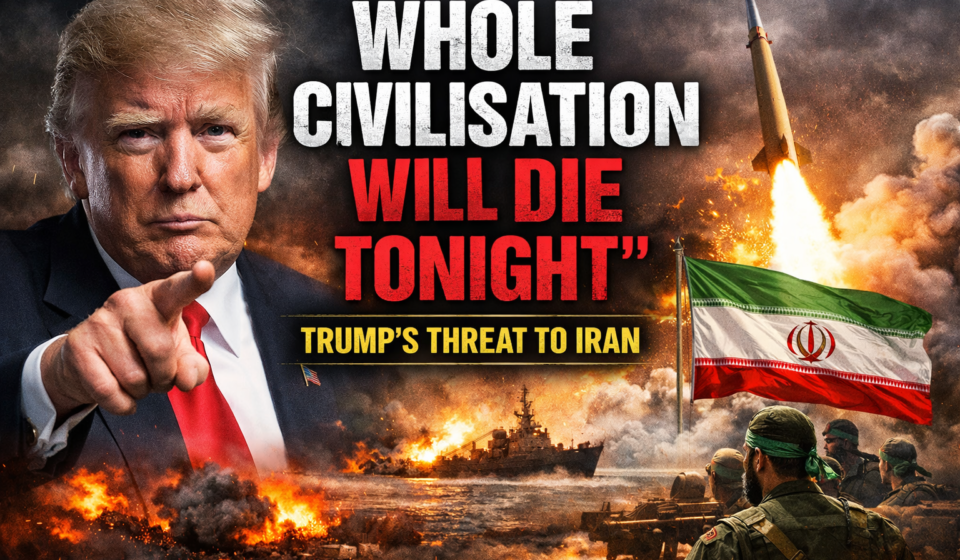

Former U.S. President Donald Trump has once again drawn global attention after issuing a powerful and controversial warning to Iran. His statement, “a whole civilisation will die tonight,” has triggered widespread concern about rising geopolitical tensions and the possibility of a large-scale conflict.
At a time when the Middle East is already facing instability, such strong rhetoric has added urgency to an already fragile situation. Governments, analysts, and global markets are now closely monitoring developments.
What Did Trump Say?
Trump’s statement was direct and alarming. He warned Iran of severe consequences if it failed to meet certain expectations, though the exact details of those demands remain unclear.
The message suggests a potential escalation in U.S. strategy toward Iran. While Trump has often used strong language in international matters, this particular statement stands out due to its intensity and timing.
Such remarks can influence not only political decisions but also public sentiment, increasing fear and uncertainty around the world.
Background of US-Iran Relations
The relationship between the United States and Iran has been tense for decades. Key issues include:
- Nuclear program concerns
- Economic sanctions
- Military presence in the Middle East
Over the years, both countries have engaged in indirect confrontations, often through allies and regional conflicts. The situation has remained unstable, with occasional spikes in tension.
Trump’s latest warning adds to this long history, raising questions about whether the situation could move toward direct confrontation.
Why the Middle East Matters
The Middle East plays a critical role in global stability due to its strategic and economic importance. One of the most crucial locations is the Strait of Hormuz.
This narrow waterway is essential for global oil transport. A significant percentage of the world’s crude oil passes through it daily. Any disruption here can have immediate global consequences.
If tensions between the U.S. and Iran escalate, the Strait of Hormuz could become a focal point, potentially affecting energy supplies worldwide.
Impact on Global Economy
A potential conflict between the U.S. and Iran could have serious economic effects:
1. Rising Oil Prices
Oil markets are highly sensitive to geopolitical risks. Even the threat of conflict can cause prices to surge.
2. Stock Market Volatility
Global markets may react negatively to uncertainty, leading to fluctuations and potential losses.
3. Trade Disruptions
Shipping routes in the Middle East could be affected, slowing down global trade and increasing costs.
Countries that rely heavily on oil imports would be among the most affected.
Impact on India
For India, the situation is particularly important. India imports a large portion of its crude oil from the Middle East.
Key concerns include:
- Higher fuel prices
- Inflation pressure
- Increased import costs
A prolonged crisis could affect multiple sectors, including transportation, manufacturing, and agriculture.
Global Reactions
Trump’s statement has received mixed reactions across the world:
- Some political leaders have called for restraint and diplomacy
- Experts have warned against escalation
- Citizens are concerned about the possibility of war
International organizations are likely to play a role in mediating tensions, although success is not guaranteed.
Military and Strategic Risks
If tensions continue to rise, several risks could emerge:
- Military strikes and retaliation
- Cyber warfare and economic sanctions
- Regional conflicts involving allied nations
Such developments could quickly escalate beyond control, affecting not just the Middle East but the entire world.
Possible Scenarios
The situation could unfold in different ways:
1. Diplomatic Resolution
Negotiations may lead to a peaceful outcome, reducing tensions.
2. Limited Conflict
Small-scale military actions could occur without turning into full war.
3. Full-Scale War
In the worst-case scenario, the conflict could expand, involving multiple countries and causing widespread damage.
Why This Situation Is Critical
What makes this situation particularly serious is the combination of strong political statements and strategic importance.
The involvement of major global powers increases the risk level. Any miscalculation could lead to unintended consequences.
The phrase “whole civilisation will die tonight” reflects the severity of the warning and highlights how quickly tensions can escalate.
Conclusion
The warning issued by Donald Trump has added a new layer of tension to an already complex geopolitical situation. As the world watches closely, the focus remains on whether diplomacy will prevail or if the situation will move toward conflict.
For now, uncertainty continues to dominate. Governments, businesses, and citizens alike are preparing for possible outcomes while hoping for stability and peace.