
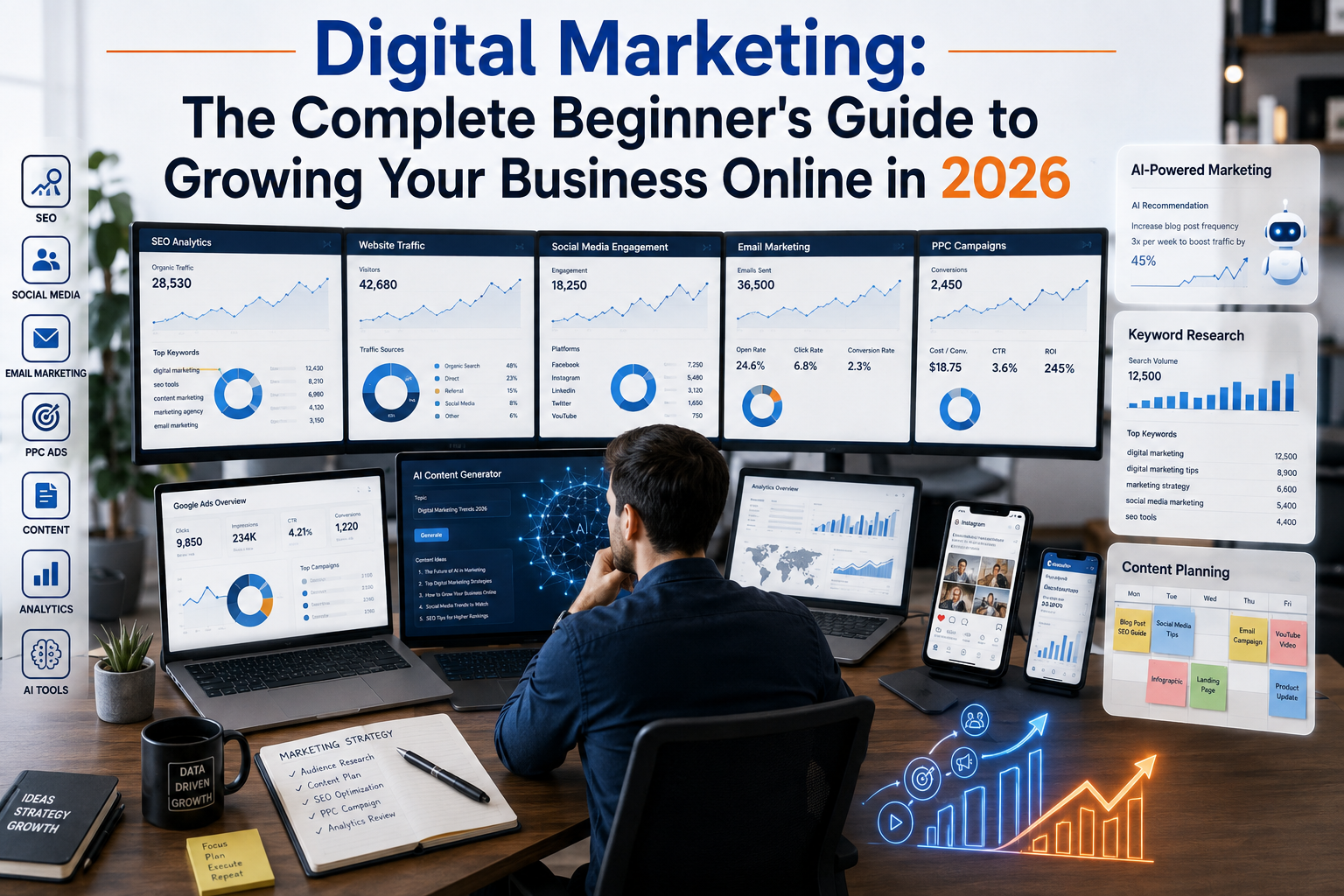
Digital Marketing: The Complete Beginner’s Guide to Growing Your Business Online in 2026

Introduction
Digital Marketing has completely changed how businesses connect with customers. Whether you own a small local shop, run an online store, or work for a large company, building a strong online presence is no longer optional. Today, people search for products, compare brands, read reviews, and make purchases online every day.
Unlike traditional advertising, digital marketing allows businesses to reach the right audience, measure results in real time, and improve campaigns based on actual data. Even with a limited budget, businesses can compete effectively by choosing the right digital marketing strategies.
In this guide, you’ll learn what digital marketing is, why it matters, its major components, current trends, and practical steps to build a successful online marketing strategy.
What is Digital Marketing?
Digital Marketing refers to promoting products, services, or brands using digital channels such as:
- Search engines
- Websites
- Social media platforms
- Mobile applications
- Online advertising
- Video platforms
The main objective is to attract visitors, generate leads, increase sales, and build lasting customer relationships.
Unlike traditional marketing, digital marketing provides measurable results, allowing businesses to understand exactly what is working.
Why Digital Marketing is Important?
Businesses of every size benefit from digital marketing because consumers spend a significant amount of time online.
Some major advantages include:
- Reach customers worldwide
- Lower marketing costs
- Better audience targeting
- Measurable campaign performance
- Higher return on investment
- Faster customer engagement
- Improved brand awareness
For example, a local restaurant can run targeted social media ads within a few kilometers of its location instead of paying for expensive newspaper advertisements.
Major Components of Digital Marketing
Search Engine Optimization (SEO)
Search Engine Optimization helps websites appear higher in search engine results.
SEO focuses on:
- Keyword research
- High-quality content
- Technical website improvements
- Internal linking
- External backlinks
- Mobile optimization
- Fast page speed
A business with strong SEO receives consistent organic traffic without paying for every visitor.
Benefits of SEO
- Long-term traffic
- Better credibility
- Higher search visibility
- Lower customer acquisition cost
Content Marketing
Content marketing involves creating valuable information that helps your audience solve problems.
Popular content includes:
- Blog articles
- Videos
- Case studies
- Infographics
- Podcasts
- E-books
- Guides
Instead of directly selling, content builds trust, making customers more likely to buy later.
Example:
A fitness company publishes weekly workout guides, attracting visitors who eventually purchase fitness programs.
Social Media Marketing
Social media platforms have become powerful marketing channels.
Businesses use platforms like:
- X
- YouTube
Social media marketing helps brands:
- Build communities
- Increase engagement
- Generate leads
- Drive website traffic
- Improve customer service
Consistency matters more than posting frequently.
Email Marketing
Email marketing remains one of the highest-performing digital marketing channels.
Businesses use email to:
- Welcome new subscribers
- Share newsletters
- Promote products
- Offer discounts
- Recover abandoned carts
- Build customer loyalty
Personalized emails generally achieve higher open and click-through rates than generic campaigns.
Pay-Per-Click (PPC) Advertising
PPC allows businesses to display advertisements on search engines and websites.
Advertisers pay only when someone clicks the ad.
Popular PPC platforms include:
- Google Ads
- Microsoft Advertising
- Social media advertising platforms
PPC delivers quick visibility while SEO focuses on long-term growth.
Affiliate Marketing
Affiliate marketing allows businesses to partner with creators or publishers who promote products in exchange for a commission.
This approach helps brands expand their reach without large upfront advertising costs.
Influencer Marketing
Influencers have established trust with their audiences.
Businesses collaborate with influencers to:
- Launch products
- Increase brand awareness
- Drive sales
- Reach niche audiences
Even micro-influencers often generate strong engagement because of their loyal communities.
How Digital Marketing Works Together
A successful digital marketing strategy combines multiple channels.
For example:
- A customer searches Google.
- They discover your SEO-optimized blog.
- They subscribe to your newsletter.
- They receive educational emails.
- They see your social media content.
- They click a paid advertisement.
- They purchase your product.
Each channel supports the others throughout the customer journey.
Building an Effective Digital Marketing Strategy
Define Clear Goals
Start by identifying what success looks like.
Examples include:
- Increase website traffic
- Generate more leads
- Improve online sales
- Grow social media followers
- Build brand awareness
Clear goals help measure campaign performance.
Understand Your Audience
Research your ideal customers by considering:
- Age
- Location
- Interests
- Buying behavior
- Online habits
- Problems they want to solve
Knowing your audience improves campaign effectiveness.
Create High-Quality Content
Good content should:
- Solve real problems
- Answer common questions
- Be easy to understand
- Include visuals
- Stay updated
Helpful content naturally attracts backlinks and improves SEO.
Optimize for Mobile Users
Most online traffic now comes from smartphones.
Your website should:
- Load quickly
- Display properly on all devices
- Have readable text
- Include simple navigation
A poor mobile experience often leads to higher bounce rates.
Measure Performance
Track important metrics such as:
- Website visitors
- Organic traffic
- Conversion rate
- Bounce rate
- Click-through rate
- Customer acquisition cost
- Return on investment
Analytics tools help identify opportunities for improvement.
Common Digital Marketing Mistakes to Avoid
Many beginners make avoidable mistakes.
Some common ones include:
- Ignoring SEO
- Posting inconsistent content
- Targeting everyone instead of a specific audience
- Not tracking campaign results
- Using poor-quality visuals
- Forgetting mobile optimization
- Focusing only on sales instead of providing value
Learning from these mistakes saves both time and money.
Practical Tips for Beginners
If you’re starting with digital marketing, follow these steps:
- Learn SEO fundamentals.
- Create a professional website.
- Publish helpful blog content regularly.
- Build an email subscriber list.
- Stay active on relevant social media platforms.
- Monitor analytics every month.
- Test different strategies.
- Keep learning as trends evolve.
Small improvements made consistently often produce impressive long-term results.
Conclusion
Digital Marketing offers businesses an effective way to attract customers, increase visibility, and grow revenue in today’s competitive online world. By combining SEO, content marketing, social media, email campaigns, and paid advertising, businesses can create sustainable growth while building strong customer relationships.
Success doesn’t happen overnight, but with consistent effort, valuable content, and data-driven decisions, your digital marketing strategy will continue to improve over time. Start with one channel, learn what works best for your audience, and gradually expand your efforts for lasting online success.
Frequently Asked Questions (FAQs)
1. What is Digital Marketing in simple words?
Digital Marketing is the process of promoting products or services through online channels such as websites, search engines, social media, email, and digital advertisements.
2. Why is Digital Marketing important for small businesses?
Digital Marketing helps small businesses reach more customers, compete with larger brands, increase sales, and measure marketing performance with a relatively small budget.
3. Which Digital Marketing strategy is best for beginners?
Search Engine Optimization (SEO), content marketing, and social media marketing are excellent starting points because they help build long-term visibility and customer trust.
4. How long does Digital Marketing take to show results?
Paid advertising can produce results within days, while SEO and content marketing generally take several months to build consistent organic traffic.
5. Is Digital Marketing a good career in 2026?
Yes. Digital Marketing continues to be one of the fastest-growing career fields, offering opportunities in SEO, content marketing, social media, paid advertising, email marketing, analytics, and marketing automation.
Tags: Digital Marketing, SEO, Content Marketing, Social Media Marketing, Email Marketing, PPC Advertising, Online Marketing, Digital Strategy, Marketing Tips, Business Growth