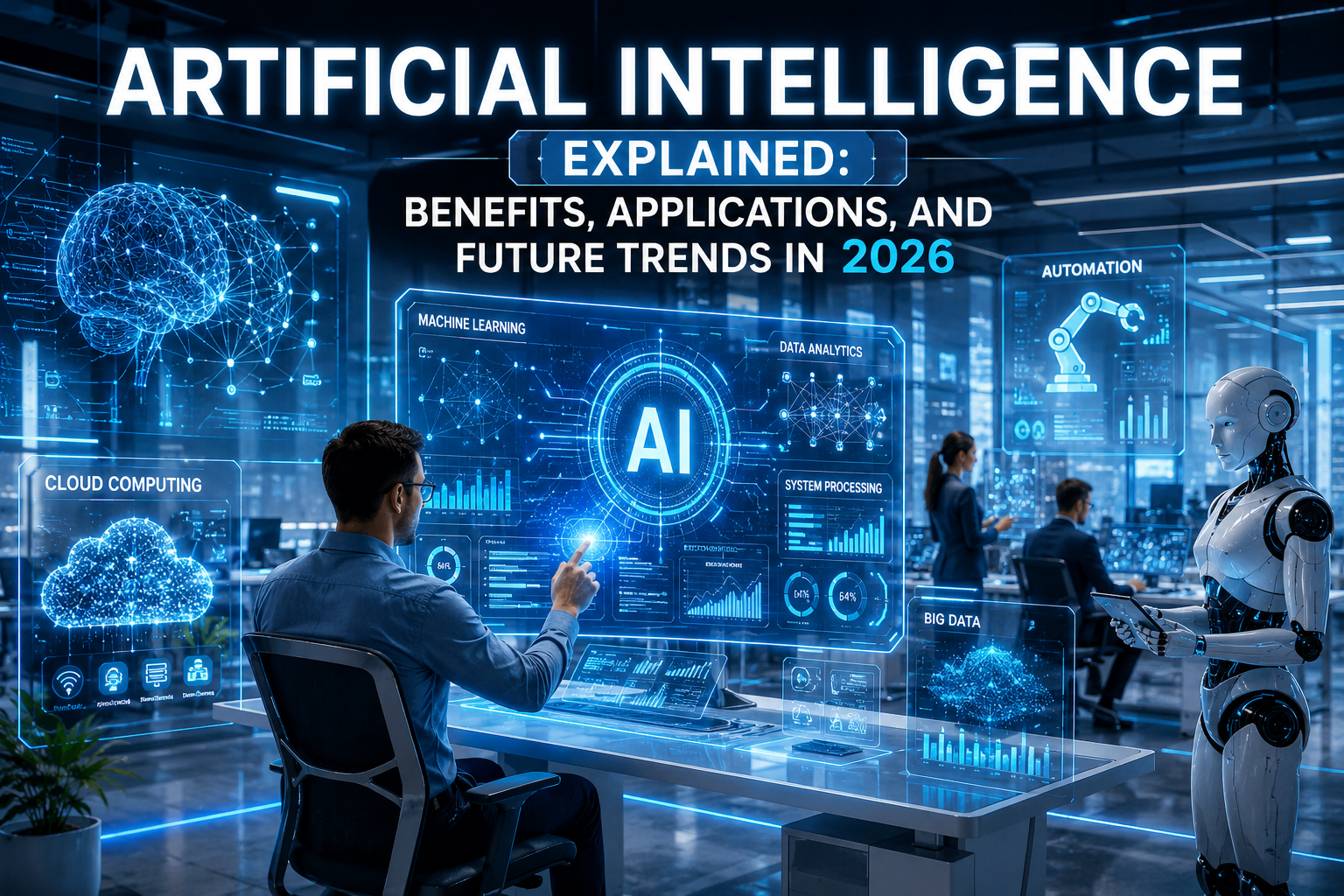
Artificial Intelligence Explained: Benefits, Applications, and Future Trends in 2026

Introduction
Artificial Intelligence has moved from science fiction to everyday life. Whether you’re unlocking your smartphone with facial recognition, asking a virtual assistant for directions, or receiving personalized shopping recommendations, AI is already working behind the scenes.
Today, Artificial Intelligence is helping businesses automate repetitive tasks, improve customer experiences, analyze massive amounts of data, and make faster decisions. As AI continues to evolve, it is transforming industries ranging from healthcare and finance to manufacturing and education. Understanding how AI works and where it is headed can help individuals and businesses prepare for a smarter digital future.
What Is Artificial Intelligence?
Artificial Intelligence is a branch of computer science that enables machines to perform tasks that normally require human intelligence. These tasks include learning from data, recognizing patterns, solving problems, understanding language, and making decisions.
Unlike traditional software that follows fixed instructions, AI systems improve over time by analyzing information and identifying patterns
Common AI technologies include:
- Machine Learning
- Deep Learning
- Natural Language Processing (NLP)
- Computer Vision
- Robotics
- Generative AI
- Predictive Analytics
Together, these technologies allow computers to perform increasingly complex tasks with greater accuracy.
How Does Artificial Intelligence Work?
Artificial Intelligence relies on algorithms and data to learn and improve.
The basic process includes:
- Collecting data from various sources.
- Training AI models using that data.
- Identifying patterns and relationships.
- Making predictions or decisions.
- Continuously improving through new data and feedback.
The more relevant and high-quality data an AI system receives, the better its performance becomes.
Types of Artificial Intelligence
Narrow AI
Narrow AI is designed to perform specific tasks.
Examples include:
- Voice assistants
- Recommendation systems
- Spam filters
- Facial recognition
- Customer support chatbots
Most AI systems used today fall into this category.
General AI
General AI refers to machines that could perform any intellectual task a human can accomplish.
Although researchers continue to make progress, General AI has not yet been achieved.
Generative AI
Generative AI creates new content based on user prompts.
It can generate:
- Articles
- Images
- Videos
- Computer code
- Music
- Business reports
Generative AI has become one of the fastest-growing areas of artificial intelligence.
Benefits of Artificial Intelligence
Increased Productivity
AI automates repetitive tasks, allowing employees to focus on strategic and creative work.
Examples include:
- Data entry
- Document processing
- Customer inquiries
- Report generation
This improves workplace efficiency while reducing manual effort.
Better Decision-Making
AI analyzes large datasets much faster than humans.
Businesses use AI to:
- Predict customer demand
- Optimize inventory
- Identify business risks
- Improve financial planning
- Analyze market trends
Data-driven insights help leaders make informed decisions.
Improved Customer Experience
Artificial Intelligence enables businesses to provide faster and more personalized services.
Examples include:
- AI-powered chatbots
- Personalized product recommendations
- Virtual shopping assistants
- Automated customer support
Customers receive quicker responses and more relevant experiences.
Reduced Operational Costs
Automation helps organizations reduce labor-intensive work and minimize costly errors.
AI can optimize:
- Supply chains
- Manufacturing processes
- Energy consumption
- Logistics
- Inventory management
These improvements often result in significant cost savings.
Real-World Applications of Artificial Intelligence
Healthcare
AI assists doctors by analyzing medical images, identifying diseases, and supporting faster diagnoses.
Hospitals also use AI for patient scheduling and predictive healthcare planning.
Finance
Banks and financial institutions use AI to:
- Detect fraud
- Assess credit risk
- Automate customer service
- Monitor financial transactions
These applications improve security and operational efficiency.
Manufacturing
Manufacturers rely on AI to monitor equipment, predict maintenance needs, and improve production quality.
AI-powered robots also assist with repetitive assembly tasks.
Retail
Retailers use AI to:
- Recommend products
- Forecast demand
- Optimize pricing
- Manage inventory
- Personalize marketing campaigns
These capabilities improve both customer satisfaction and profitability.
Education
Educational platforms use AI to personalize learning experiences, automate assessments, and provide students with customized recommendations.
Teachers also benefit from AI-powered administrative tools.
Future Trends in Artificial Intelligence
The future of Artificial Intelligence will continue to influence every major industry.
Emerging trends include:
- AI-powered business assistants
- Autonomous vehicles
- Intelligent robotics
- AI-driven cybersecurity
- Personalized healthcare
- Smart manufacturing
- Advanced language models
- Responsible and ethical AI development
Businesses that embrace these innovations will be better positioned for long-term success.
Best Practices for Adopting Artificial Intelligence
If your organization is planning to implement AI, consider these recommendations:
- Identify clear business goals.
- Start with small pilot projects.
- Use high-quality data.
- Invest in employee training.
- Monitor AI performance regularly.
- Prioritize ethical AI practices.
- Strengthen cybersecurity measures.
- Continuously evaluate new AI technologies.
These steps help maximize the value of AI investments while reducing implementation risks.
Conclusion
Artificial Intelligence is transforming the way people work, communicate, and solve problems. From automating routine tasks to supporting complex decision-making, AI is creating new opportunities across every industry.
While challenges such as data privacy and ethical concerns require careful attention, the long-term benefits of Artificial Intelligence are substantial. Organizations that adopt AI strategically, invest in skilled employees, and embrace continuous innovation will be well prepared for the future. Now is the right time to explore how AI can improve your business and unlock new possibilities for growth.
Frequently Asked Questions (FAQs)
1. What is Artificial Intelligence?
Artificial Intelligence is a technology that enables computers and machines to perform tasks that normally require human intelligence, such as learning, problem-solving, language understanding, and decision-making.
2. How is Artificial Intelligence used in everyday life?
AI is used in voice assistants, search engines, online shopping recommendations, navigation apps, fraud detection, customer service chatbots, and smart home devices.
3. What are the main benefits of Artificial Intelligence?
Artificial Intelligence improves productivity, automates repetitive tasks, enhances decision-making, reduces operational costs, increases efficiency, and delivers better customer experiences.
4. What industries benefit the most from Artificial Intelligence?
Healthcare, finance, retail, manufacturing, education, transportation, logistics, and digital marketing are among the industries benefiting significantly from AI technologies.
5. What is the future of Artificial Intelligence?
The future of Artificial Intelligence includes more advanced automation, intelligent business systems, personalized healthcare, autonomous vehicles, ethical AI development, and wider adoption across industries, making it one of the most important technologies shaping the modern world.