
Search engine optimization (SEO) is one of the most powerful ways for companies to grow online. When it comes to SEO for B2B, the goal is simple — help other businesses find your services on Google.
If you are just starting, understanding how SEO for B2B works can completely change how you generate leads. Instead of chasing customers, you attract them organically.
In this beginner guide, you will learn how SEO helps B2B businesses grow, what strategies work, and how you can start step by step.
Table of Contents
What Is SEO for B2B
SEO for B2B means optimizing your website so that businesses can find your services through search engines like Google.
For example, if someone searches for “B2B lead generation strategies” and your blog appears, that is the result of SEO.
Unlike general marketing, SEO for B2B focuses on attracting decision-makers, companies, and professionals who are actively searching for solutions.
Why SEO Is Important for B2B Businesses
SEO is not just about traffic. It is about attracting the right audience.
Here is why it matters:
- Brings targeted business traffic
- Generates high-quality leads
- Builds long-term authority
- Reduces dependency on paid ads
According to
https://blog.hubspot.com/marketing/seo
SEO is one of the most effective long-term strategies for growth.
How SEO Helps B2B Businesses Grow
1. Increases Organic Visibility
When your content ranks on Google, your business becomes visible to potential clients without paid ads.
2. Generates High-Quality Leads
SEO brings users who are already searching for solutions. This increases conversion chances.
👉 Learn more about lead generation strategies
3. Builds Trust and Authority
Businesses trust companies that appear on top of search results. Ranking improves credibility.
4. Supports Long-Term Growth
Unlike ads, SEO continues to generate traffic even months after publishing content.
Key SEO Strategies for Beginners
Keyword Research
Start by finding what your target audience is searching for. Focus on relevant business keywords.
Content Creation
Write blogs that solve real problems. High-quality content is the backbone of SEO.
👉 Understand the basics of B2B marketing
On-Page SEO
Optimize:
- Title
- Meta description
- Headings
- Images
Internal Linking
Connect your blogs together. This helps Google understand your website structure.
Technical SEO
Ensure your website:
- Loads fast
- Works on mobile
- Has clean URLs
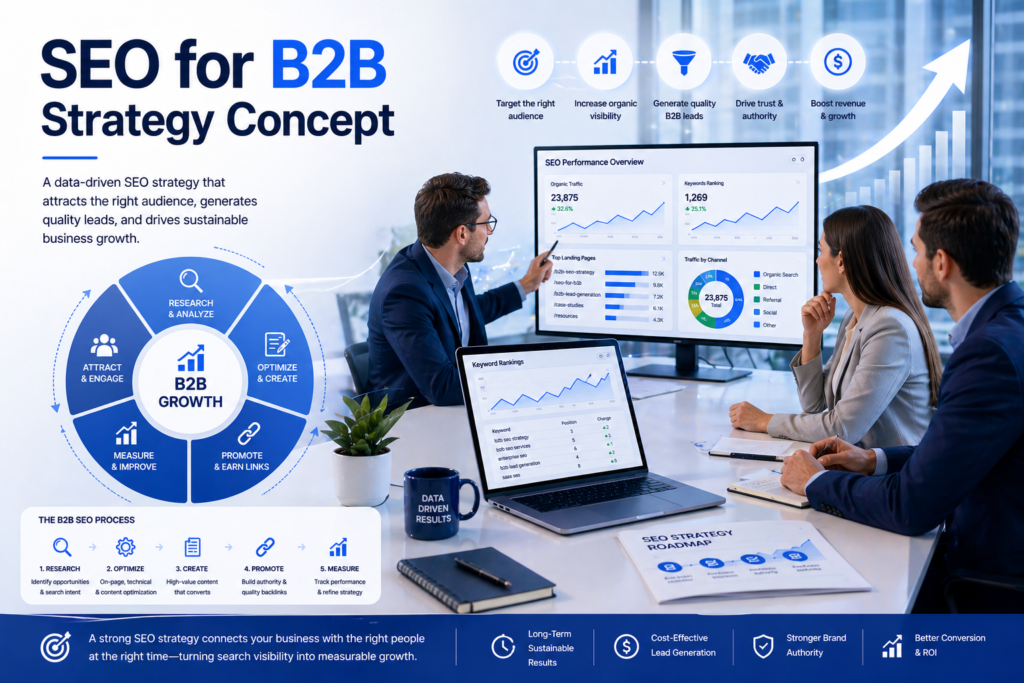
Real Example of SEO Growth
A B2B company publishes blogs targeting keywords like “business lead generation” and “marketing strategies.”
Over time:
- Their content ranks on Google
- They attract business visitors
- They convert leads without paid ads
This is how SEO builds a scalable system.
Common SEO Mistakes
Avoid these mistakes:
- Ignoring keyword research
- Writing low-value content
- Not optimizing images
- Lack of internal linking
- Inconsistent posting

Future of SEO for B2B in 2026
SEO is evolving with new trends:
- AI-driven search results
- Voice search optimization
- Personalized content
- Data-driven marketing
Businesses that adapt early will gain a strong advantage.
Conclusion
SEO for B2B is not a quick win, but it is one of the most powerful long-term strategies for business growth.
By focusing on content, keywords, and user intent, you can attract high-quality leads and build authority in your niche.
Start simple, stay consistent, and keep improving your content.
Call to Action
If you are starting your journey, explore more guides on SEO and marketing strategies to build your knowledge step by step.
❓ FAQs
What is SEO for B2B in simple terms
SEO for B2B means optimizing your website so other businesses can find your services on Google.
Is SEO important for B2B businesses
Yes, SEO helps generate organic traffic and high-quality leads without relying on ads.
How long does SEO take to work
SEO usually takes a few weeks to months, depending on competition and content quality.
Can beginners learn SEO for B2B
Yes, beginners can start with basic strategies like keyword research and content creation.
What is the best SEO strategy for beginners
Focus on content, keywords, and internal linking for long-term growth.