


The State of B2B Buying in 2026: How AI, Research and Digital Behavior Are Changing Decisions
Table of Contents
B2B buying trends in 2026 show a more digital, independent and AI-assisted research journey.
Business buyers now have access to enormous amounts of information before they ever speak with a salesperson. They can compare vendors, read expert analysis, watch demonstrations, explore customer reviews and increasingly use artificial intelligence to summarize information and investigate possible solutions.
At the same time, major business purchases still involve risk.
Buyers need confidence that a product will work, integrate with existing systems, meet security requirements, deliver measurable value and receive support after implementation.
This combination is changing the B2B buying journey.
In 2026, successful companies need to understand not only who their buyers are, but also how they research, who influences their decisions, where they look for information and what creates enough confidence for a buying group to move forward.
B2B Buying Trends in 2026: Beyond the Traditional Funnel
Traditional B2B marketing often described the buyer journey as a straightforward funnel.
A prospect became aware of a problem.
They researched possible solutions.
They contacted vendors.
They compared alternatives.
Finally, they selected one.
Modern buying behavior is rarely this predictable.
Buyers may move between stages several times.
They may discover a vendor through an article, research competitors, stop the project, return months later and involve additional stakeholders.
Some members of the buying group may already be familiar with the category while others are starting from the beginning.
One stakeholder may be reviewing technical requirements while another is evaluating cost.
This means businesses should stop assuming that every buyer follows the same path.
The modern buying journey is better understood as a network of research, evaluation and internal discussions.
Buyers Are Doing More Research Independently
One of the biggest changes in B2B purchasing is the amount of research buyers can conduct without directly contacting a vendor.
Company websites now provide product information, pricing guidance, demonstrations, implementation material and customer stories.
Buyers also use:
- Search engines
- Industry publications
- Professional communities
- Vendor websites
- Comparison platforms
- Online events
- Video content
- Social media
- Analyst reports
- Peer recommendations
- Artificial intelligence tools
This gives buyers greater control over the early stages of the purchase.
A potential customer may already understand several vendors before filling out a form or speaking with sales.
For businesses, this changes an important question.
Instead of asking only, “How do we generate a lead?” companies also need to ask, “How useful are we while buyers are conducting research independently?”
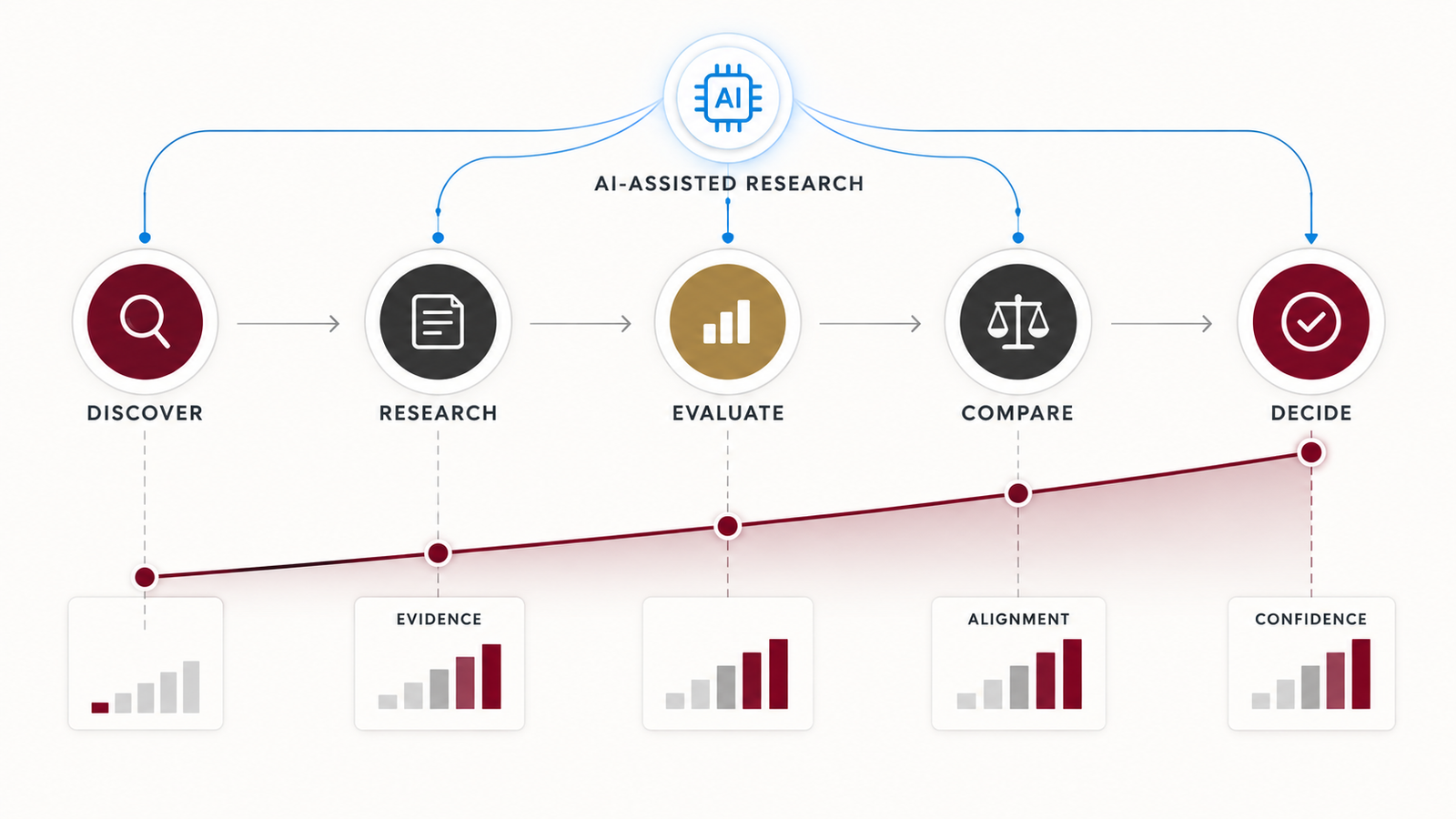
AI Is Becoming Part of the Research Process
Artificial intelligence is adding another layer to B2B research.
Instead of opening many webpages and manually comparing every source, buyers can increasingly use AI tools to help summarize information.
A business buyer might ask an AI assistant to:
- Explain a technology category
- Compare different approaches
- Summarize vendor capabilities
- Create a list of evaluation questions
- Explain technical terminology
- Identify possible risks
- Organize research notes
- Prepare a comparison framework
This can make early-stage research faster.
But AI also changes how businesses need to present information.
If product information is vague, inconsistent or difficult to understand, buyers may struggle to evaluate the company clearly.
Organizations evaluating AI-enabled tools can also refer to the NIST AI Risk Management Framework when considering trust, risk and accountability.
Organizations need content that explains what they do, who they serve, how their solutions work and where their capabilities are most relevant.
Clear information becomes increasingly important when humans and AI tools may both be interpreting it.
AI-assisted research is also changing how business buyers evaluate vendors.
Search Behavior Is Becoming More Conversational
Traditional search behavior often relied on short keyword phrases.
A buyer might search for:
“best CRM software”
or:
“B2B data provider”
AI-powered search and conversational assistants allow people to ask much more detailed questions.
For example:
“Which CRM platforms are suitable for a 500-person B2B software company with sales teams across three countries?”
or:
“What should I compare when evaluating B2B data providers for an APAC demand generation campaign?”
These queries contain far more context.
This means businesses need content that answers real questions rather than simply repeating broad keywords.
Helpful content should explain problems, alternatives, limitations, implementation considerations and decision criteria.
These B2B buying trends in 2026 are also making search more conversational and context-driven.
The more useful the information is, the more valuable it becomes during buyer research.
Buying Groups Are Becoming More Important
Large B2B purchases rarely depend on one person.
A buying group may include representatives from several departments.
For example, an enterprise software purchase could involve:
- Department leadership
- IT
- Security
- Finance
- Procurement
- Legal
- Operations
- End users
- Senior management
Each stakeholder evaluates the purchase differently.
An executive may focus on business impact.
An IT leader may evaluate integration.
Security teams may investigate data protection.
Finance may look at cost and expected return.
Procurement may review commercial terms.
The vendor therefore needs to satisfy multiple questions at the same time.
A single sales presentation may not be enough.
Businesses need information that helps different stakeholders understand how the solution affects their responsibilities.
Internal Agreement Can Be Harder Than Vendor Selection
A company may identify several suitable vendors and still struggle to make a decision.
Why?
Because purchasing often requires internal agreement.
Different stakeholders may have different priorities.
One department may want more capabilities.
Another may be concerned about implementation complexity.
Finance may question the cost.
Security may require additional review.
Leadership may want stronger evidence of business value.
This creates internal friction.
A strong vendor can help reduce that friction.
Useful materials might include:
- Implementation plans
- Security documentation
- ROI frameworks
- Product comparisons
- Customer examples
- Integration information
- Procurement documentation
- Executive summaries
The goal is to help the buyer communicate internally.
A vendor that makes the purchase easier to explain may have an advantage over one that simply provides more features.
Buyers Expect Greater Transparency
Modern B2B buyers are increasingly uncomfortable with unnecessary information barriers.
If basic information is difficult to find, buyers may simply move to another company.
Transparency can include areas such as:
- What the product does
- Who it is designed for
- How implementation works
- What integrations are available
- What support is provided
- How pricing is structured
- What limitations exist
- How customer data is handled
Not every company can publish exact pricing.
Enterprise products may depend on usage, customization or contract requirements.
But buyers still benefit from understanding the commercial model.
For example, a company could explain whether pricing is based on users, usage, data volume or service level.
Transparency helps buyers decide whether it is worth continuing the conversation.
Trust Is Becoming More Valuable
More information does not automatically create more confidence.
Buyers are surrounded by advertisements, marketing claims, AI-generated content and sales messages.
This makes trust increasingly important.
Businesses need evidence.
Evidence can come from:
- Customer stories
- Case studies
- Product demonstrations
- Clear methodology
- Independent reviews
- Research
- Certifications
- Security documentation
- Expert commentary
- Transparent explanations
Strong content should help buyers understand why they should believe a claim.
For example, saying a product “improves productivity” is broad.
Explaining which processes become faster and how the improvement is achieved provides much more value.
Trust grows when businesses communicate clearly and consistently.
Buyers Want Evidence Before Making Large Decisions
The greater the purchase risk, the more evidence buyers usually require.
An inexpensive software subscription may be easy to test.
A large enterprise technology investment is different.
The buyer may need to justify the decision to senior leadership.
They may need to demonstrate expected value.
Technical teams may need proof that implementation is realistic.
This means businesses should provide evidence at different levels.
A case study may demonstrate results.
A technical document may explain integration.
A demonstration may show the user experience.
An ROI framework may help finance teams evaluate the business case.
The strongest buying experiences give stakeholders enough information to make confident decisions.
Peer Influence Remains Powerful
Business buyers do not rely only on vendor information.
They also want to know what other professionals think.
Peer recommendations can carry significant weight because buyers often trust people who have faced similar challenges.
Peer influence may come from:
- Professional communities
- Colleagues
- Industry events
- Customer reviews
- Social networks
- Advisory groups
- Existing partners
This is particularly important in categories where many vendors appear similar.
A recommendation from someone with practical experience can help reduce uncertainty.
Businesses therefore need to think beyond traditional promotional activity.
Customer experience becomes part of marketing.
Satisfied customers can become powerful sources of credibility.
Social Media Is Part of B2B Research
Professional social platforms have become important places for discovering ideas and evaluating companies.
Buyers may encounter:
- Industry commentary
- Product announcements
- Customer stories
- Research
- Executive perspectives
- Employee expertise
- Event discussions
This means a company’s reputation is increasingly distributed across multiple channels.
A buyer may form an opinion about a business before ever visiting its website.
The quality of public communication matters.
Organizations that consistently share useful expertise can build recognition long before a direct sales opportunity appears.
Content Needs to Support Different Stages
Not every buyer needs the same information.
Someone beginning research may need educational material.
Someone comparing vendors may need detailed product information.
Someone preparing for internal approval may need commercial and implementation documentation.
Businesses should therefore build content for different stages.
Early-stage content may include:
- Market trends
- Educational guides
- Research
- Problem explanations
Evaluation-stage content may include:
- Solution guides
- Comparisons
- Demonstrations
- Technical information
Decision-stage content may include:
- Case studies
- Security information
- Implementation plans
- ROI material
- Procurement documentation
The purpose is not to force buyers through a rigid sequence.
It is to make useful information available when they need it.
Website Experience Matters More Than Ever
A company’s website is often one of the most important research environments in the B2B buying journey.
If the website is confusing, slow or difficult to navigate, buyers may struggle to find answers.
A useful B2B website should make important information easy to discover.
Visitors should quickly understand:
- What the company offers
- Who the solution is designed for
- What problems it solves
- Where to find detailed information
- How to contact the company
- Where to explore additional resources
Navigation should reflect how buyers think.
A buyer should not need to understand the company’s internal organizational structure just to find relevant information.
Clear categories and strong search functionality improve the research experience.
Mobile Research Cannot Be Ignored
B2B purchases may ultimately happen on desktop devices, but research does not happen only at desks.
Executives and professionals frequently read articles, open emails and review information on mobile devices.
This makes mobile usability important.
Pages should load quickly.
Text should remain readable.
Navigation should be simple.
Forms should not require unnecessary fields.
A poor mobile experience can interrupt research even if the desktop website is well designed.
Businesses need to assume that buyers will interact with content across multiple devices.
Buyers Expect Faster Responses
Digital experiences have changed expectations around speed.
Buyers do not always want to wait several days for information.
If someone requests a document, they expect immediate access.
If a buyer asks a straightforward question, they may expect a quick response.
Automation can help businesses respond faster.
For example, systems can:
- Deliver requested resources immediately
- Route inquiries
- Schedule meetings
- Answer common questions
- Notify sales teams
- Prepare account information
However, speed should not replace quality.
A fast but irrelevant response can be worse than a slightly slower and genuinely useful one.
Personalization Needs to Be Relevant
Buyers increasingly expect communication that reflects their situation.
But personalization does not mean adding a first name to every message.
Useful personalization can consider:
- Industry
- Role
- Company size
- Region
- Business challenge
- Previous interaction
- Buying stage
A finance executive and a technical manager may need different information about the same solution.
The objective is to make communication more relevant.
Poor personalization can create the opposite effect.
If a company uses incorrect information or makes inaccurate assumptions, trust can decline quickly.
Personalization therefore depends on reliable data.
Buyers Are More Sensitive to Irrelevant Outreach
Automation has made it easier for companies to send large numbers of messages.
That also means buyers receive more irrelevant communication.
Generic outreach can quickly become noise.
A message is more likely to earn attention when it demonstrates that the sender understands the recipient’s business context.
This does not require extremely complicated personalization.
Even basic relevance can make a difference.
For example, communicating with the correct role about a genuine business problem is more useful than sending the same message to every person in a database.
Quality increasingly matters more than quantity.
Salespeople Are Becoming Validators and Advisors
As buyers conduct more research independently, the role of sales changes.
Salespeople may become involved later in the journey.
When they do become involved, buyers may already understand the category and several competing solutions.
This means simply repeating website information provides little value.
Strong salespeople need to add context.
They can help buyers:
- Understand trade-offs
- Evaluate implementation
- Clarify requirements
- Identify potential risks
- Build an internal business case
- Compare different approaches
The salesperson increasingly becomes an advisor rather than simply a source of basic product information.
This makes expertise more important.
Self-Service and Human Support Need to Work Together
Digital self-service and human sales should not be treated as competing models.
Buyers may want both.
They may prefer to conduct early research independently.
Later, they may want an expert to answer detailed questions.
A strong buying experience allows customers to move between these options easily.
Someone researching independently should be able to contact sales when needed.
A salesperson should also be able to direct buyers toward useful self-service resources.
The best experience gives buyers control.
They can choose the interaction that makes sense for their current stage.
Security and Privacy Influence Buying Decisions
Data security and privacy have become important buying considerations across many B2B categories.
Even when a purchase is not primarily related to cybersecurity, buyers may want to understand how information is protected.
Questions may include:
- Where is data stored?
- Who can access it?
- What security controls are used?
- What happens when data is deleted?
- Which third parties process information?
- How is access monitored?
Businesses that prepare this information early can make the evaluation process smoother.
The NIST Privacy Framework is also a useful reference for identifying and managing privacy risk.
Security reviews often become a significant part of enterprise purchasing.
Having clear documentation can reduce unnecessary delays.
Procurement Has Greater Influence
Procurement teams play an important role in many B2B buying decisions.
Their involvement may include:
- Vendor evaluation
- Commercial negotiation
- Contract review
- Supplier risk
- Payment terms
- Compliance requirements
Marketing and sales teams should therefore consider procurement as part of the broader buying group.
A company may successfully convince the primary business user but still lose momentum during procurement.
Providing clear commercial information and responding efficiently to documentation requests can improve the buying experience.
Buyers Need Help Understanding Implementation
One of the biggest concerns in complex B2B purchases is implementation.
A product may look impressive, but buyers want to know what happens after the contract is signed.
They may ask:
- How long will implementation take?
- What resources are required?
- Who needs to participate?
- What systems need integration?
- Is training required?
- What support is available?
- What could delay the project?
Businesses should address these questions early.
Clear implementation information can reduce perceived risk.
Buyers are more confident when they understand the path from purchase to actual value.
Existing Customers Influence New Purchases
The buying journey does not end after the contract is signed.
Customer experience affects future buyers.
Satisfied customers may provide references, recommendations and reviews.
Poor experiences can also become visible.
This means customer success is closely connected to future growth.
Businesses that consistently deliver value create a stronger reputation in the market.
That reputation can influence buyers who have never interacted directly with the company.
Customer retention and acquisition are therefore more connected than they may appear.
Data Helps Businesses Understand Buyer Behavior
Modern buying journeys create many signals.
B2B data intelligence helps companies connect buyer signals and make more informed decisions.
Website visits, content engagement, event participation, email interaction and sales conversations all provide information.
When these signals are connected, organizations can better understand how buyers move through the journey.
They may identify:
- Which content attracts early interest
- Which accounts are becoming more active
- Which stakeholders are involved
- Which channels influence opportunities
- Where buyers commonly stop progressing
This helps companies improve the buying experience.
Data should not simply be collected.
It should help answer meaningful questions about customer behavior.
Businesses Need to Reduce Friction
Every unnecessary step creates friction.
Long forms create friction.
Hidden information creates friction.
Slow responses create friction.
Confusing navigation creates friction.
Repeatedly asking buyers for information they have already provided creates friction.
Companies should examine the entire buying journey and identify where unnecessary effort exists.
Reducing friction does not mean removing important qualification or security processes.
It means designing those processes more intelligently.
The easier it is for buyers to find information and complete necessary steps, the more professional the experience feels.
The Future of B2B Buying
B2B buying is likely to become even more digitally assisted.
AI may help buyers continuously evaluate markets and vendors.
Research may become increasingly conversational.
Buying groups may use shared AI tools to summarize information and compare options.
Vendor websites may become more interactive.
Sales teams may receive better intelligence about account activity before conversations begin.
At the same time, human trust will remain important.
Large business decisions involve uncertainty.
People still want reassurance from knowledgeable experts, credible customers and trusted colleagues.
The future is therefore unlikely to be completely automated.
Instead, digital systems and human expertise will increasingly work together throughout the buying journey.
Final Thoughts
B2B buying in 2026 is becoming more independent, more informed and more complex.
Buyers have access to more information.
Artificial intelligence is helping them research faster.
Multiple stakeholders are participating in decisions.
Digital self-service is becoming more important.
Trust, transparency and evidence are becoming increasingly valuable.
Businesses need to adapt.
The strongest companies will not simply generate more marketing activity.
They will make it easier for buyers to understand their options, evaluate risk, gain internal agreement and move forward with confidence.
Ultimately, successful B2B buying experiences will be built around one simple principle:
Help buyers make better decisions.
Pingback: AI Automation in 2026: Intelligent Workflows | RichDataInsights
Pingback: B2B Data Intelligence in 2026
Pingback: B2B Data Intelligence in 2026: Smarter Business Decisions