

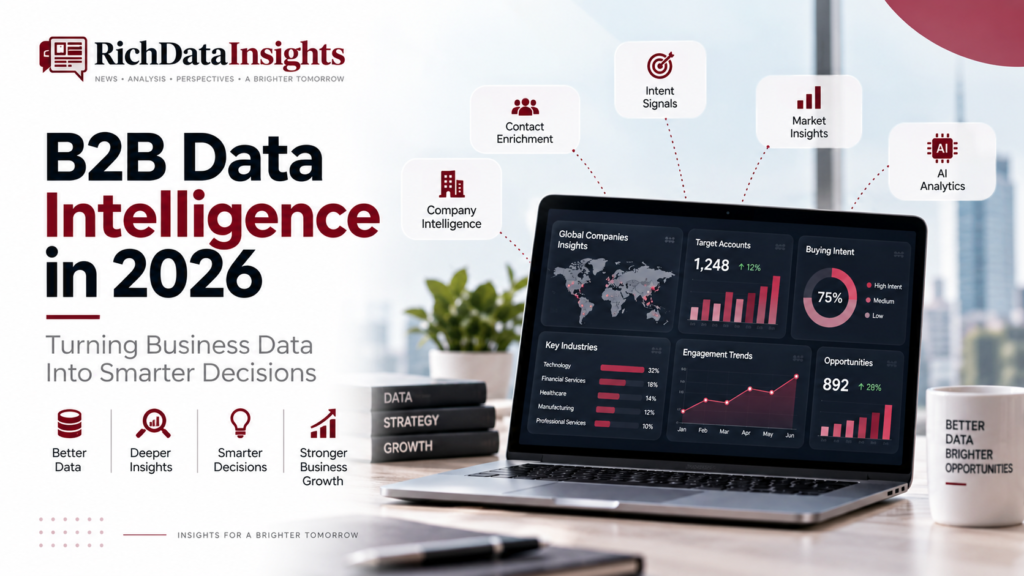
B2B Data Intelligence in 2026: Turning Business Data Into Smarter Decisions
Table of Contents
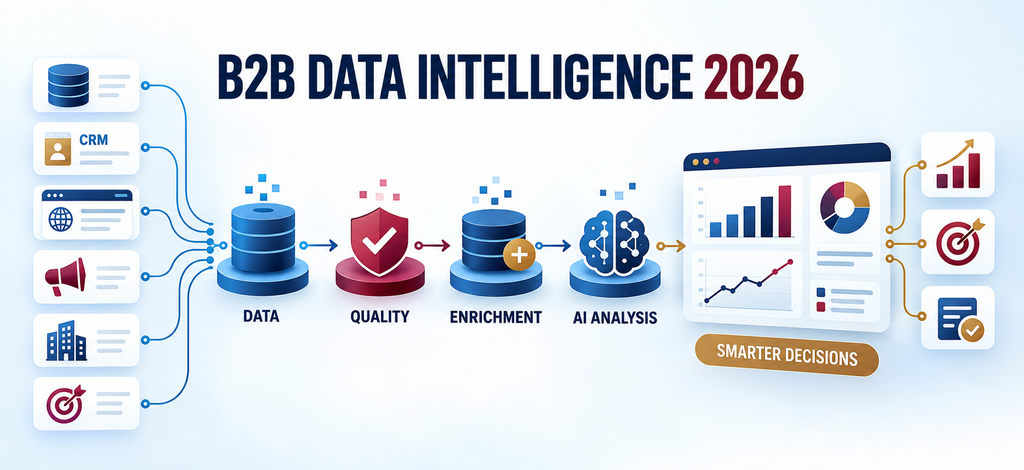
Businesses today have access to more information than ever before. CRM records, website activity, campaign engagement, sales conversations, company details, customer interactions and third-party datasets can all provide valuable business signals.
For modern B2B teams, B2B data intelligence in 2026 is becoming the bridge between scattered information and confident business decisions.
The challenge is no longer simply collecting more data.
The real challenge is understanding what the information means and turning it into useful decisions.
B2B data intelligence in 2026 is becoming an important part of sales, marketing and business strategy. Organizations are moving away from disconnected spreadsheets and isolated databases toward connected systems that help teams understand companies, buyers, opportunities and changing market behavior.
Companies that maintain accurate data, connect information across systems and turn it into practical intelligence can make faster and more informed decisions.
What B2B Data Intelligence Means
B2B data intelligence in 2026 helps organizations transform business information into useful insights about companies, customers, prospects and markets.
Traditional B2B data may include:
- Company name
- Industry
- Location
- Employee size
- Revenue range
- Contact name
- Job title
- Department
- Email address
This information is useful, but it provides only a basic view of an account or contact.
Data intelligence adds context and helps businesses answer important questions:
- Is this company a good fit for our business?
- Who are the important people inside the organization?
- Which accounts are engaging with our content?
- Which companies appear to be showing increased interest?
- Which records need to be updated?
- Which accounts should sales prioritize?
- Which market segments are performing best?
Instead of simply storing information, data intelligence helps teams understand what action they should take next.
Data Quality Is the Foundation
Before a business can build advanced intelligence systems, it needs reliable information. Reliable B2B data intelligence in 2026 depends on accurate records, consistent fields and regular validation.
Poor-quality data can create problems throughout sales, marketing and customer operations. A company database may contain the same organization several times under different names. A contact may have changed jobs. An email address may no longer work. A business may also be assigned to the wrong industry.
These issues may seem small individually, but they can affect targeting, reporting, automation and decision-making when they occur across thousands of records.
Common data-quality problems include:
- Duplicate records
- Missing information
- Invalid email addresses
- Outdated job titles
- Incorrect company information
- Inconsistent industry classifications
- Different naming formats
- Incomplete account relationships
This is why data cleaning and validation should happen before advanced analytics or automation.
Without trusted records, B2B data intelligence in 2026 can produce recommendations that look useful but lead teams in the wrong direction.
Reliable intelligence starts with reliable data.
Data Enrichment Adds Valuable Context
A basic contact record may contain only a person’s name, email address and company. That information alone may not provide enough context for modern B2B activities.
Data enrichment adds additional details that make a record more useful.
For an individual, enrichment may include:
- Job function
- Seniority
- Department
- Location
- Professional role
- Company information
For a business, enrichment may include:
- Industry
- Employee size
- Headquarters
- Geographic presence
- Technology environment
- Revenue range
- Company structure
This additional context allows organizations to create more relevant audiences.
Instead of sending the same message to thousands of contacts, teams can build campaigns for specific industries, markets, company sizes or professional roles.
This is one of the practical benefits of B2B data intelligence in 2026 because richer records help teams make more precise audience decisions.
For many teams, B2B data intelligence in 2026 becomes more useful when enrichment connects a basic record with the business context behind it.
Better context leads to better targeting.
Account Intelligence Creates a Bigger Picture
B2B purchases are usually made by organizations rather than isolated individuals.
Several people from the same company may interact with a business before a purchase takes place. One person may read an article, another may attend a webinar, someone else may visit a product page and a senior manager may later speak with sales.
If every interaction is viewed separately, the larger pattern can be missed.
Account intelligence brings these activities together. Account-based B2B data intelligence in 2026 allows teams to review engagement across an organization rather than judging interest from one contact alone.
Teams can ask:
- How many people from this account are active?
- Which departments are engaging?
- Is activity increasing?
- Are senior employees involved?
- Which topics are attracting attention?
- Does the company match the target customer profile?
This creates a clearer picture of potential business interest.
This is where B2B data intelligence in 2026 becomes more useful than a basic contact database.
Understanding the Buying Group
Complex B2B purchases rarely involve only one decision-maker.
A buying group may include people from several areas of an organization, including:
- IT leaders
- Technical specialists
- Finance teams
- Procurement
- Operations
- Department managers
- Senior executives
Each person evaluates the purchase differently.
Technical teams may focus on integration and security. Finance may focus on cost. Procurement may evaluate contracts and risk. Executives may consider strategic impact.
B2B data intelligence in 2026 can help businesses identify these relationships. Instead of relying on one contact, sales and marketing teams can build a broader understanding of the people involved in a buying decision.
This broader view is closely connected to the modern B2B buying journey, where several stakeholders can influence the final decision.
The broader purpose of B2B data intelligence in 2026 is to help teams understand the full buying group and reduce dependence on a single contact.
Intent Signals Add Timing
Company and contact information help businesses understand who they may want to reach.
Intent and engagement signals provide clues about when an account may deserve attention. B2B data intelligence in 2026 becomes more useful when these signals are connected with account and contact information.
These signals may include:
- Website visits
- Content downloads
- Webinar attendance
- Email engagement
- Product-page activity
- Event participation
- Campaign responses
- Repeated interaction with specific topics
One signal does not necessarily mean that a company is ready to buy. A visitor may simply be conducting research.
However, multiple relevant signals appearing over time can help businesses understand which accounts are becoming more active.
For example, imagine two companies with similar industry and employee profiles. One has shown no recent engagement. The other has several employees visiting relevant pages, reading content and attending a webinar.
The second account may deserve greater attention.
This timing layer makes B2B data intelligence in 2026 more useful than a static list of company and contact details.
Intent signals therefore add useful timing to traditional business data.
AI Is Changing Data Intelligence
Artificial intelligence is changing how organizations analyze information. AI is also changing how B2B data intelligence in 2026 can be used across sales, marketing and research workflows.
Many businesses have more data than employees can review manually. AI can help process larger amounts of information, identify patterns and highlight potentially important changes.
AI-assisted systems can support activities such as:
- Data classification
- Account research
- Record enrichment
- Duplicate detection
- Audience segmentation
- Account prioritization
- Campaign analysis
- Research summarization
- Lead scoring
- Trend identification
For example, an AI system could review account activity and identify companies showing unusually high engagement. Another system could categorize thousands of company records according to shared characteristics.
These capabilities are part of the wider shift toward AI automation in 2026, where connected systems support faster and more informed business decisions.
For B2B data intelligence in 2026, AI can improve speed and scale, but human oversight remains important. Technology can identify patterns, while people still need to understand the business context behind those patterns.
Predictive Intelligence Can Improve Prioritization
Many businesses have more potential customers than their sales teams can realistically engage.
This creates an important question:
Which accounts should receive attention first?
Traditional scoring models often use simple rules. A company may receive points because of its size, industry or previous engagement.
Predictive models make B2B data intelligence in 2026 more useful by analyzing a wider combination of signals, including:
- Company characteristics
- Historical conversions
- Engagement patterns
- Marketing interactions
- Buying-group activity
- Sales activity
- Account behavior
The system can then help teams identify accounts that may have stronger potential.
This does not mean that an algorithm should automatically make every sales decision. Predictive intelligence should support decision-making, not replace professional judgment.
The goal of B2B data intelligence in 2026 is to give salespeople better evidence while allowing them to combine those insights with their own knowledge of customers, industries and markets.
Connected Data Creates Better Intelligence
One of the biggest challenges for organizations is that valuable information is often spread across different systems.
This is one of the main reasons B2B data intelligence in 2026 depends on connected systems rather than isolated databases.
Customer information may exist inside a CRM. Marketing engagement may exist inside an email platform. Website activity may exist inside analytics software. Campaign performance may exist inside advertising platforms. Intent information may come from another system.
If these platforms do not communicate, teams see only part of the customer journey.
Connecting data can create a much more useful picture.
A sales representative could see:
- Company information
- Relevant decision-makers
- Recent website activity
- Email engagement
- Event participation
- Previous conversations
Marketing teams could understand whether campaign engagement eventually resulted in sales opportunities.
Leadership could see how different activities contribute to pipeline and revenue.
Connected systems make B2B data intelligence in 2026 more actionable because teams can work from a shared view of the customer journey.
Connected data turns isolated information into practical business intelligence.
Better Data Improves Audience Targeting
Successful targeting is not simply about reaching more people.
It is about reaching people who are relevant to the business. B2B data intelligence in 2026 helps organizations build audiences using characteristics such as:
- Country
- Region
- Industry
- Company size
- Job function
- Seniority
- Technology environment
- Account status
- Engagement
- Buyer activity
This makes campaigns more focused.
For example, instead of targeting every technology professional, a company might focus on senior cybersecurity decision-makers at enterprise businesses in a specific market.
The practical value of B2B data intelligence in 2026 is that better targeting can reduce wasted activity and improve message relevance.
Personalization Becomes More Meaningful
Personalization should go beyond inserting a person’s first name into an email.
Useful personalization considers the person’s business context. With B2B data intelligence in 2026, teams can use information such as:
- Industry
- Job function
- Company size
- Region
- Business challenge
- Technology environment
- Account activity
A finance executive and an IT leader may care about completely different aspects of the same product.
Data intelligence allows businesses to understand these differences.
This makes B2B data intelligence in 2026 useful for creating communication that is relevant without requiring a completely different campaign for every person.
The goal is to make communication more relevant to the situation of the buyer.
Sales Intelligence Should Lead to Action
Sales teams do not need more dashboards simply because more information is available.
They need intelligence that helps them decide what to do next. B2B data intelligence in 2026 should help sales teams move from information to a clear next action.
Useful sales intelligence may answer questions such as:
- Which accounts have recently become more active?
- Which companies match our strongest customer profile?
- Which contacts should we approach?
- Which accounts contain multiple engaged stakeholders?
- Which opportunities require follow-up?
- What topics are buyers researching?
The easier it is to find these answers, the more time salespeople can spend speaking with customers instead of searching through systems.
When B2B data intelligence in 2026 is connected to daily sales workflows, it can simplify decisions rather than create additional complexity.
Marketing Intelligence Should Connect Activity With Results
Marketing teams generate large amounts of data.
Email opens, advertisements, website visits, downloads and campaign interactions all create measurable activity. However, activity alone does not always indicate business success.
B2B data intelligence in 2026 also helps marketing teams connect campaign activity with later business outcomes.
Marketing intelligence should help teams understand:
- Which campaigns created qualified engagement
- Which segments performed best
- Which accounts became opportunities
- Which content influenced buyers
- Which channels contributed to pipeline
- Which campaigns generated meaningful results
This gives marketers a more complete understanding of performance.
This connection makes B2B data intelligence in 2026 useful for deciding where future budgets and resources should be invested.
Data Intelligence Supports Better Market Research
Data intelligence is useful beyond individual sales opportunities.
Organizations can analyze their databases to understand wider market patterns. B2B data intelligence in 2026 can reveal industries with increasing engagement, job functions that respond to particular content and markets where demand appears to be growing.
This information can support decisions about:
- Market expansion
- Product positioning
- Campaign planning
- Content strategy
- Sales territories
- Audience development
When data is analyzed at a broader level, it can help businesses understand where future opportunities may exist.
Data Governance Becomes Essential
As organizations collect and connect more information, data governance becomes increasingly important. As B2B data intelligence in 2026 expands, governance must grow with it.
Businesses need clear rules covering how information is handled.
These rules may include:
- Who can access data
- Where information is stored
- How long records are retained
- How incorrect information is updated
- How permissions are managed
- How privacy requirements are followed
- Which systems can use customer information
Organizations can also use resources such as the NIST AI Risk Management Framework to think more systematically about AI-related risks.
The NIST Privacy Framework can also help organizations identify and manage privacy risks.
Strong governance becomes particularly important when AI systems are connected to business databases.
Organizations should understand which information AI can access and which actions automated systems are allowed to perform.
Human Oversight Still Matters
Automation can improve speed, but business information is rarely perfect. Human review keeps B2B data intelligence in 2026 grounded in real business context.
A system may incorrectly classify a company. A job title may not accurately represent someone’s responsibilities. An engagement signal may appear important but have little commercial meaning.
People can understand context that automated systems may not recognize.
This is why human oversight remains important.
Machines are useful for processing large amounts of information. People are better at evaluating ambiguity, relationships and business context.
The strongest data-intelligence environments combine both capabilities.
Building a Strong Data Intelligence Foundation
Organizations do not need to transform everything at once.
A practical B2B data intelligence in 2026 strategy begins by identifying the information that matters most. For many B2B organizations, this includes:
- Company information
- Contact information
- Account relationships
- Marketing engagement
- Sales activity
- Customer history
The next step is improving data quality.
Duplicate records can be removed. Important fields can be standardized. Outdated information can be reviewed. Systems can then be connected so information moves consistently between platforms.
After the foundation is reliable, businesses can introduce capabilities such as enrichment, intent signals, predictive scoring and AI-assisted analysis.
The order is important.
The value of B2B data intelligence in 2026 increases when the underlying information can be trusted.
The Future of B2B Data Intelligence
B2B data systems are likely to become increasingly automated.
As B2B data intelligence in 2026 matures, connected systems will help teams act on reliable information with less manual effort.
Instead of employees manually checking dashboards, intelligent systems may continuously monitor account activity and notify teams when important changes occur.
A salesperson might receive a summary explaining that several decision-makers at a target account have recently become active.
Marketing systems could adjust campaigns when engagement changes.
Data platforms may automatically identify records that require validation or enrichment.
Organizations may also become better at understanding the relationships between people, accounts, opportunities and buying groups.
The result will be business intelligence that operates closer to real time.
However, stronger automation will make data quality and governance even more important. Automated systems can move quickly, but if the information beneath them is unreliable, they can also spread mistakes quickly.
Final Thoughts
B2B data intelligence in 2026 is becoming an important foundation for modern sales, marketing and business operations.
Organizations already have access to enormous amounts of information. The challenge is turning that information into useful decisions.
Clean data creates reliability.
Enrichment provides context.
Account intelligence creates a broader view of customers.
Intent signals add timing.
Connected systems provide a clearer customer journey.
AI can make analysis faster.
Human expertise provides judgment.
Businesses that combine these capabilities effectively can understand markets more clearly, prioritize opportunities more intelligently and use their resources more efficiently.
The future of B2B intelligence will not simply be about who owns the most data.
It will be about who can turn that data into the clearest understanding of customers, markets and opportunities.
Pingback: B2B Buying Trends in 2026 | RichDataInsights
Pingback: Global AI Regulation in 2026: What Businesses Need to Know
Pingback: B2B Demand Generation in 2026: AI, Intent Data and Buying Groups Driving Pipeline - RichDataInsights