

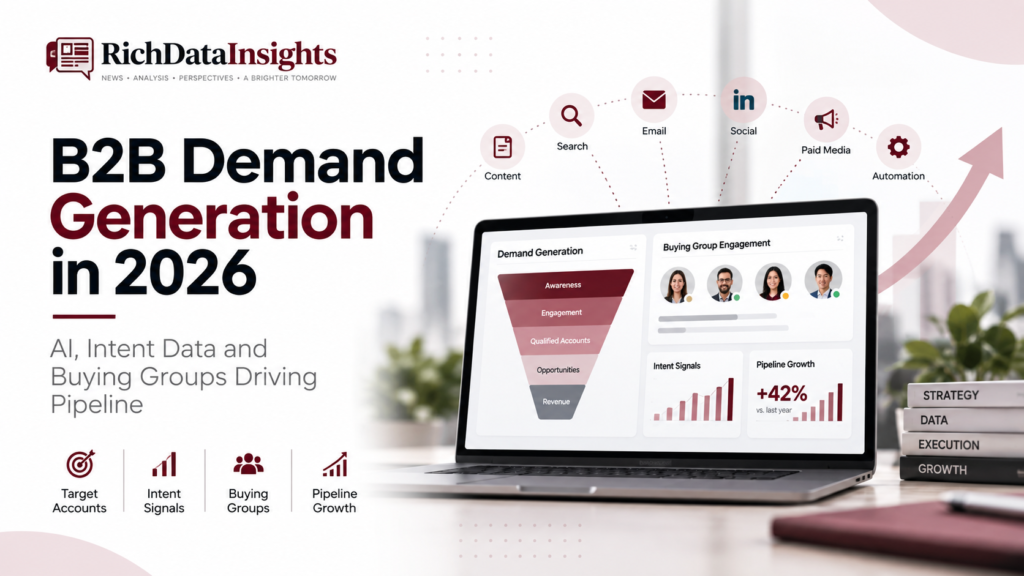
B2B Demand Generation in 2026: AI, Intent Data and Buying Groups Driving Pipeline
Table of Contents
B2B demand generation in 2026 is moving beyond the goal of collecting as many leads as possible. Marketing teams are working to identify the right accounts, understand the people involved in each purchase, recognize meaningful buying signals and connect their activity to qualified pipeline.
Artificial intelligence is accelerating that shift. It can help teams research accounts, summarize engagement and coordinate routine campaign work. Intent data adds context about what organizations may be researching. Buying-group insights help marketers reach the different people who shape a decision. Together, these capabilities can make demand generation more relevant—but only when they are supported by reliable data, useful content and close sales alignment.
What B2B demand generation looks like in 2026
Lead generation usually focuses on capturing an individual contact through a form, event, advertisement or download. Demand generation is broader: it builds awareness, helps buyers understand a problem, supports their research and creates the conditions for a qualified opportunity.
That wider view matters because many business purchases involve a network of stakeholders. Forrester’s 2026 Buyer Insights report says a typical buying decision includes 13 internal stakeholders and nine external influencers. Forrester also reports that procurement professionals are decision-makers in 53% of business buying cycles. These findings show why one contact’s form submission rarely tells the whole story. (Forrester’s 2026 business buying research)
How buying groups shape B2B demand generation
People in a buying group evaluate a solution from different angles. A technical evaluator may focus on security and integration. Finance may examine cost and return on investment. Procurement may assess contract terms and risk, while an executive considers strategic impact.
A B2B demand generation program should make it easier for each stakeholder to understand the business case. That means creating role-relevant information: technical documentation for evaluators, financial evidence for budget owners, implementation details for operations teams and concise value summaries for executives.
The goal is not to send every person the same sequence of emails. It is to give the buying group consistent, useful answers as members compare options and build internal agreement. A larger group can make coordination harder, but it also gives the organization more perspectives for evaluating a purchase. Forrester reports that 94% of buyers in groups of six or more see clear benefits from working as a group, including shared validation and a better ability to secure budget.
How intent data strengthens B2B demand generation
Firmographic and contact data can show who an account is: its industry, size, location and relevant roles. Intent and engagement signals can add clues about what the account may be exploring now.
For B2B demand generation teams, signals can include repeat visits to solution pages, engagement with relevant research, webinar attendance, campaign responses or activity across professional platforms. These actions are useful clues, but no single signal proves that a company is ready to buy. A page visit may be research, a student project or simple curiosity.
A well-run B2B demand generation strategy uses intent data alongside account fit and other evidence. For example, a company that matches the ideal customer profile and shows sustained engagement from several relevant roles may deserve follow-up before a similar company with no recent activity. Sales teams should be able to see why an account was prioritized and what evidence supports the recommendation.
AI in B2B demand generation workflows
AI can help B2B demand generation teams work through repetitive research and analysis more quickly. Depending on the tools and data available, it may assist with:
- Summarizing account and industry research.
- Grouping accounts by shared characteristics or behavior.
- Identifying changes in engagement across an account.
- Drafting and adapting content for different buyer roles.
- Recommending follow-up actions for a marketer or salesperson to review.
- Finding gaps in campaign reporting or audience data.
These uses are most valuable when they solve a defined workflow problem. Teams should check generated research and recommendations, use approved data, and keep a person responsible for consequential decisions. AI can help surface a pattern; it does not automatically establish that the pattern is accurate or that a prospect is qualified.
How AI and self-service are changing B2B demand generation
AI is changing the buyer’s side of the journey as well. Buyers can use generative AI to summarize information, compare options or prepare questions before talking with a vendor. This means some research may happen before a person visits a company’s website or fills in a form.
Forrester’s 2026 research describes generative AI search as a starting point for B2B buyers, while also emphasizing their reliance on colleagues and external influencers to justify decisions and reduce risk. Clear, factual content can help buyers understand a solution, but businesses should make their claims specific and easy to validate.
For B2B demand generation teams, digital research and human sales can work together. In a May 2026 survey, Gartner reported that 70% of B2B buyers prefer a completely digital, self-service buying experience and 67% prefer a sales-representative-free experience. At the same time, 69% said they turn to sales representatives to validate AI-generated insights. The findings suggest that buyers value control over early research and still want knowledgeable help when they need confidence or context. (Gartner’s 2026 buyer survey)
Content that supports B2B demand generation across the buying journey
Effective B2B demand generation content should answer buyer questions rather than exist only to capture contact details. A useful content plan covers several stages:
- Early research: educational articles, industry trends and problem explainers.
- Solution evaluation: detailed guides, webinars, product information and comparisons.
- Internal justification: case studies, ROI models, security details and implementation plans.
- Final validation: demonstrations, trials, references and answers to procurement questions.
Make important information easy to find and understand. Gated assets can still be useful when they offer meaningful value, but requiring a form for every basic answer can frustrate buyers who prefer to research independently.
Account engagement in B2B demand generation
An individual click rarely tells the complete story. Imagine that several people from one target company read an article, attend a webinar and visit a solution page over a few weeks. Each action may look modest on its own. Together, they may indicate growing account interest.
Account-level reporting helps B2B demand generation teams bring relevant activity into one view. It can help marketing and sales see which organizations are engaging, which roles are involved and what questions may still need answers. Treat this as context for a conversation, not as proof that an account has an active project.
Coordinate B2B demand generation across channels and sales
B2B buyers may encounter a company through search, social media, an advertisement, an event, email or a sales conversation. B2B demand generation teams do not need to use every channel. They need to coordinate the channels their audience actually uses and make the message consistent across them.
B2B demand generation works better when marketing and sales agree on qualification rules. Define what makes an account a fit, which roles matter, what engagement deserves follow-up and how buying-group activity will be interpreted. Shared rules reduce disagreements about whether a contact is ready for sales and help prevent teams from optimizing for form fills that do not become opportunities.
Reliable data for B2B demand generation
AI and automation support B2B demand generation only when the underlying information is reliable. Duplicate records, outdated contacts, inconsistent company names and missing account relationships can undermine targeting and reporting.
Set clear processes for validation, standardization, deduplication, suppression and account matching. Connect CRM, campaign, advertising and analytics systems using consistent identifiers. For a related overview, see our guide to B2B data intelligence in 2026. Review data quality regularly, especially when automated workflows are making recommendations based on multiple sources.
Measure B2B demand generation by pipeline quality
B2B demand generation teams can use impressions, clicks and lead totals to understand campaign activity. They do not show on their own whether demand generation is producing business value.
Connect campaign measures to outcomes such as qualified account engagement, opportunities created, pipeline influenced, conversion rates, cost per qualified opportunity and revenue. Keep the definitions consistent across teams and be clear about what “influenced” means in your reporting.
A large pipeline is not automatically a healthy one. Evaluate whether opportunities match the ideal customer profile, involve relevant stakeholders and progress through the sales process. A smaller number of well-matched opportunities may be more valuable than a higher volume of poorly qualified leads. LinkedIn’s 2026 marketing guidance also highlights a shift toward relevance, trust and intent in demand generation. (LinkedIn’s 2026 demand generation insights)
How to build a stronger B2B demand generation strategy
A practical B2B demand generation strategy can use these steps to bring AI, intent data and buying-group insights into one program:
- Define your ideal customer profile. Specify the organizations most likely to benefit from your solution.
- Map the buying group. Identify the roles involved and the questions each role needs answered.
- Plan useful content. Cover early research, evaluation, internal approval and final validation.
- Combine signals carefully. Use intent and engagement to add context to account fit, not as a substitute for qualification.
- Apply AI to clear workflow needs. Review its outputs and keep ownership of decisions with the appropriate team.
- Agree on sales handoffs. Set shared rules for when an account or contact merits follow-up.
- Measure downstream outcomes. Track qualified opportunities, pipeline progression and revenue alongside campaign activity.
What comes next for B2B demand generation?
B2B demand generation is becoming more coordinated and more informed by data. AI may help teams identify changes in account activity and prepare recommended actions. Buying-group intelligence can help marketers plan for more than one decision-maker. AI-assisted discovery is also making clear, trustworthy information more important throughout the buyer journey.
The strongest programs will use these capabilities to make the experience more relevant and helpful. They will not rely on automation alone. Reliable data, useful content, human judgment and sales alignment will still determine whether engagement turns into a real opportunity.
Final thoughts on B2B demand generation in 2026
B2B demand generation in 2026 is shifting from lead volume toward account understanding and pipeline quality. AI can speed up research and routine work. Intent data can help teams interpret engagement. Buying-group insights can reveal whose needs a campaign should address.
Strong B2B demand generation depends on how well organizations bring those pieces together. Focus on the accounts that can benefit, give every stakeholder useful information, coordinate marketing with sales and measure progress through qualified pipeline. That is how demand generation can support sustainable revenue growth.