


Enterprise AI Agents: How Autonomous Workflows Are Changing Business in 2026
Table of Contents
Enterprise artificial intelligence is entering a new phase. Instead of simply answering questions, summarizing information or generating content, enterprise AI agents are increasingly being designed to perform actions, coordinate tasks and participate directly in business workflows.
In 2026, the conversation around artificial intelligence is shifting from copilots that assist employees to intelligent agents that can execute parts of a process across multiple systems. These agents can interpret requests, access approved business information, use connected tools and complete defined tasks while escalating exceptions to people.
This does not mean enterprises are removing humans from business processes. The more important shift is toward new operating models where employees define goals, supervise outcomes and provide judgment while AI systems handle increasing amounts of routine execution.
Recent enterprise research reflects this direction. Deloitte reported in August 2026 that 74% of surveyed leaders expect nearly half of their business processes to be redesigned or rebuilt around AI agents within four years, while 75% agreed that collaboration between humans and AI agents creates more value than automation alone. At the same time, only 5% said their business processes were highly prepared for AI agents, highlighting the gap between ambition and operational readiness.
What Are Enterprise AI Agents?
Enterprise AI agents are software systems designed to pursue a defined objective by reasoning through a task, accessing relevant information and taking approved actions.
A traditional chatbot generally waits for a user to ask a question and then provides a response. An AI agent can potentially continue beyond the response.
For example, instead of simply telling a salesperson which companies match a target profile, an agent could help interpret the targeting requirement, search approved data sources, identify matching accounts, enrich company information and prepare the results for human review.
The important difference is the movement from answering toward executing.
Microsoft has similarly described the enterprise shift as moving beyond reactive AI toward agents that participate in workflows and execute long-running work across areas such as support, finance, HR, software development and operations.
From Copilots to Autonomous Workflows
The first generation of enterprise generative AI largely focused on assisting employees.
A user could ask AI to draft an email, summarize a meeting, analyze a document or generate ideas. The employee remained responsible for moving the work between different applications and completing each step.
Agentic AI changes this model.
Instead of helping with only one isolated task, an agent can potentially manage a sequence of connected actions.
A sales workflow might include:
- interpreting a targeting request
- checking account information
- enriching contact records
- evaluating qualification criteria
- assigning a priority score
- creating a CRM task
- notifying the appropriate salesperson
The employee may supervise the process rather than manually completing every step.
This is why AI workflow automation is becoming such an important enterprise technology trend.
How Enterprise AI Agents Work
An effective enterprise agent normally requires more than an AI model.
The system also needs access to approved business context, tools, permissions and rules.
Several components are particularly important.
Business Context
Agents need relevant organizational information.
This might include CRM records, product information, customer history, internal documents, policies or structured databases.
Without reliable context, even a capable AI model may produce inaccurate or irrelevant results.
Tools and Integrations
An agent may need permission to interact with business systems.
For example, it could query a database, update a CRM record, generate a report or trigger another workflow.
These integrations transform AI from an information interface into a system capable of taking action.
Rules and Permissions
Organizations need to define exactly what an agent can and cannot do.
An agent that can read information may not necessarily be allowed to modify it.
High-risk actions might require employee approval before execution.
Memory and State
Some workflows take place over minutes, hours or even days.
Agents may therefore need to maintain information about previous actions, decisions and pending tasks.
Human Oversight
People remain important for judgment, exceptions and accountability.
The most useful enterprise systems are likely to combine automation with clearly defined human checkpoints.
Where AI Agents Are Being Used in Business
The potential applications of AI agents in business extend across many functions.
Sales and Revenue Operations
Sales teams often work across CRM platforms, prospect databases, email systems and research tools.
Agents can potentially help consolidate parts of this process.
An AI sales agent might research an account, summarize recent activity, identify relevant contacts and prepare information for a salesperson before outreach.
The objective is not necessarily to automate the relationship between buyer and seller.
Instead, AI can reduce repetitive research and administrative work so employees spend more time on higher-value conversations.
Marketing Operations
Marketing teams manage audience research, campaign execution, content, reporting and data.
Agentic workflows can help coordinate these activities.
For example, an AI system could analyze campaign performance, identify unusual changes, summarize findings and suggest actions to the marketing team.
Agents could also support audience segmentation, campaign QA and lead-routing processes.
Customer Support
Customer support is another natural area for agentic systems.
An AI agent could identify a customer’s issue, review previous interactions, retrieve relevant information and suggest or execute an approved resolution.
More complex cases can then be escalated to employees with the relevant context already assembled.
Finance and Operations
Agents may help organizations process documents, reconcile information, monitor workflows and identify exceptions.
Instead of replacing financial or operational professionals, these systems can reduce the time spent manually moving data between applications.
IT and Software Development
Software engineering has become one of the earliest areas where agents are being used to perform increasingly complex tasks.
Agents can assist with coding, testing, debugging and issue management.
Microsoft noted in 2026 that moving agents from prototypes into production creates additional requirements around authentication, enterprise knowledge, durable execution, observability and evaluation.
Multi-Agent Systems Could Change Enterprise Automation
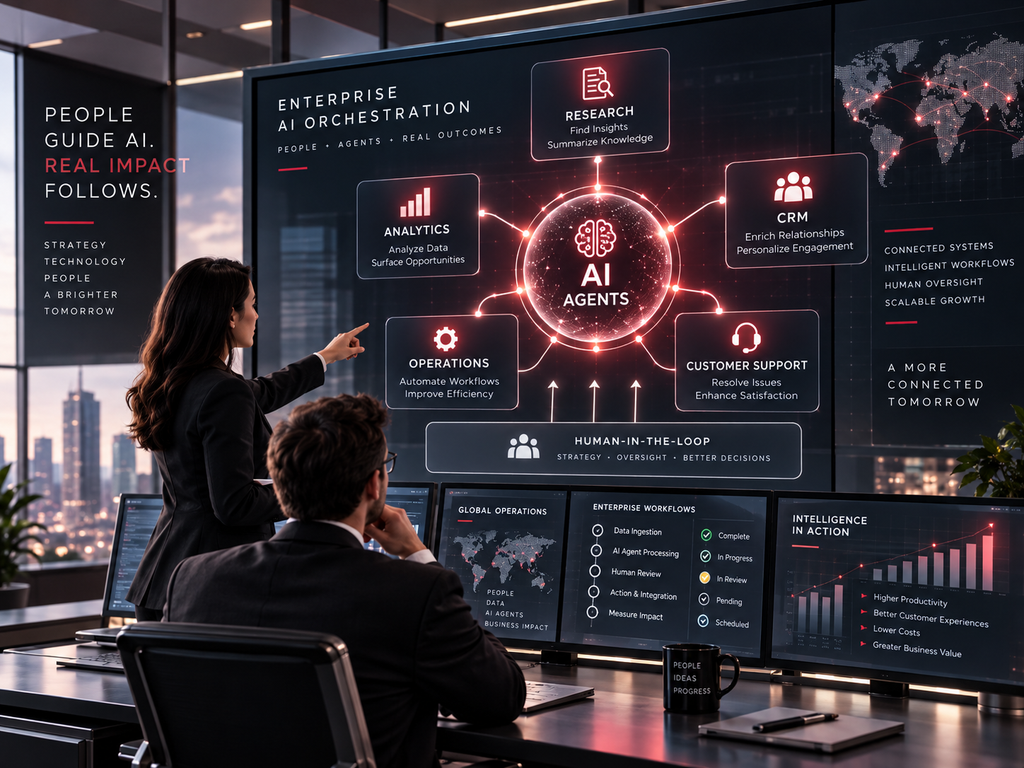
One emerging development is the use of multiple specialized agents within the same workflow.
Instead of one AI agent attempting to perform every task, organizations can design different agents for different responsibilities.
For example:
Research Agent
Collects relevant company information.
Data Agent
Checks and enriches records.
Qualification Agent
Evaluates records against defined criteria.
CRM Agent
Updates the appropriate business system.
Quality Agent
Checks outputs before delivery.
An orchestration layer can coordinate these agents and determine which one should perform each task.
Microsoft has described a similar progression toward an “orchestrator” model in which multiple agents operate across a workflow while people manage exceptions and provide direction.
Human-AI Collaboration Remains Essential
The idea of fully autonomous organizations attracts attention, but enterprise adoption is likely to develop more gradually.
Important business decisions often involve context, judgment and responsibility that should remain with people.
The strongest operating model may therefore be human-directed autonomy.
People define objectives and boundaries.
Agents execute approved tasks.
Employees review sensitive outcomes and manage exceptions.
This approach allows businesses to benefit from automation without handing unrestricted control to AI systems.
Deloitte’s 2026 research reinforces this point: 75% of surveyed leaders said human collaboration with AI agents creates more value than AI-powered automation alone.
Governance and Security Become More Important
The more actions an agent can perform, the more important governance becomes.
A chatbot producing an incorrect answer creates one type of risk.
An autonomous agent changing customer records, sending communications or triggering financial processes creates a much larger one.
Organizations therefore need controls around:
- identity and authentication
- access permissions
- approved tools
- sensitive data
- action limits
- audit logs
- human approvals
- monitoring
- model evaluation
Enterprise agents should not be treated as unrestricted digital employees.
They should operate within defined technical and business boundaries.
Microsoft’s own guidance on governing agents emphasizes security, privacy, compliance and clearly scoped permissions as organizations scale agent adoption.
Data Quality Still Determines AI Quality
Agents can automate workflows, but they cannot automatically repair every weakness in enterprise data.
If customer records contain incorrect information, duplicate accounts or outdated contact details, AI agents may simply automate decisions based on poor inputs.
Data quality therefore becomes even more important in an agentic environment.
Organizations need reliable data foundations, clear definitions and governance processes so that agents have trustworthy information to work with.
This connects directly with the broader shift toward AI in global business, where artificial intelligence is increasingly integrated with enterprise data, workflows and decision-making systems.
The Challenge Is Moving From Demo to Production
Building a simple AI-agent demonstration can be relatively easy.
Running an agent reliably inside a real enterprise is much harder.
Production systems need to deal with:
- authentication
- permissions
- data access
- failures
- monitoring
- compliance
- cost
- scalability
- changing business rules
This explains why enterprise readiness remains uneven.
Deloitte’s August 2026 research found that only 15% of surveyed organizations had scaled orchestrated, cross-functional multi-agent adoption, even though expectations for future use are extremely high.
The challenge is therefore becoming less about whether businesses can build an agent and more about whether they can operate agents safely at scale.
How Businesses Can Prepare for Enterprise AI Agents
Organizations do not need to automate every workflow immediately.
A better strategy is to start with processes that are repetitive, measurable and sufficiently structured.
Identify a Clear Business Problem
Start with a specific operational challenge rather than deploying agents simply because the technology is available.
Map the Existing Workflow
Understand how the process currently works, which systems it touches and where employees make decisions.
Improve the Data Foundation
Agents need accurate and accessible information.
Poor data quality will weaken even sophisticated AI systems.
Define Agent Permissions
Determine which information the agent can access and which actions it can perform.
Add Human Approval Where Needed
Sensitive or irreversible actions should have clear approval mechanisms.
Measure Outcomes
Track business metrics such as processing time, quality, cost, conversion rates or error reduction.
The objective should be measurable business improvement rather than simply maximizing the number of AI agents deployed.
Measuring the Value of Agentic AI
Organizations will increasingly need to evaluate agentic systems using business outcomes.
Useful metrics may include:
- hours of manual work reduced
- workflow completion time
- accuracy
- number of exceptions
- customer satisfaction
- revenue impact
- operational cost
- employee productivity
This is important because an impressive demonstration does not necessarily produce measurable enterprise value.
The most successful implementations will likely be the ones where AI is tightly connected to a specific business objective.
What Enterprise AI Agents Mean for the Future of Work
Autonomous AI agents are unlikely to eliminate the need for people across organizations.
They are more likely to change what employees spend their time doing.
Routine coordination, data gathering and repetitive processing can increasingly be handled by software.
Employees can focus more on strategy, relationships, creativity, negotiation and complex decisions.
Microsoft’s 2026 enterprise AI direction similarly emphasizes systems in which people increasingly direct outcomes while agents execute steps across connected applications.
This could fundamentally change how businesses design teams and workflows.
What Comes Next for Agentic AI
The next stage of enterprise AI agents will likely involve deeper integration between agents, business applications and organizational data.
Instead of employees opening several systems to complete a workflow, they may increasingly interact with an intelligent orchestration layer that coordinates those systems behind the scenes.
Multi-agent systems may also become more common, with different agents specializing in research, analysis, execution and quality control.
At the same time, governance platforms will become increasingly important as businesses need visibility into what agents are doing, which information they access and how decisions are made.
The long-term opportunity is not simply more automation.
It is the redesign of how work moves through an organization.
Final Thoughts
Enterprise AI agents represent an important evolution in business automation.
In 2026, organizations are moving beyond AI systems that only generate answers toward systems capable of participating in real workflows.
The biggest opportunity is not replacing employees with autonomous software.
It is creating environments where people and AI work together: humans provide goals, context and judgment while agents perform defined operational tasks.
Businesses that succeed with agentic AI will need more than advanced models. They will require reliable data, strong integrations, clear governance, careful monitoring and well-designed human oversight.
As these foundations improve, enterprise AI agents could become an increasingly important layer connecting data, applications, workflows and people across modern organizations.