


B2B Marketing in 2026: AI, Data and Buyer Trends Driving Growth
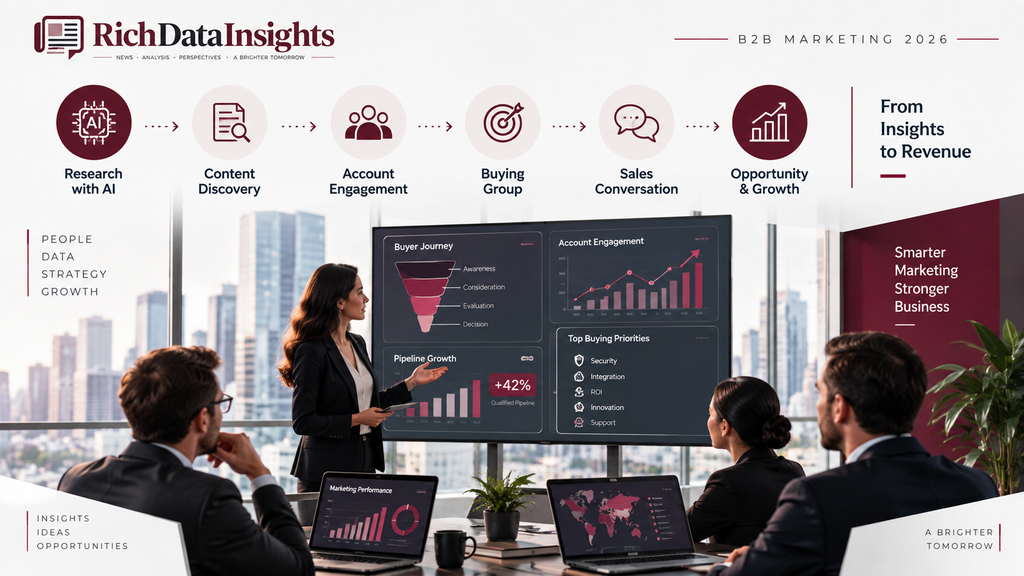
B2B marketing in 2026 is becoming more intelligent, data-driven and buyer-led. Artificial intelligence is changing how prospects research products, buying groups are becoming more complex, and marketing teams are under increasing pressure to connect activity directly with measurable business outcomes.
The traditional model of generating a large number of leads and passing them immediately to sales is becoming less effective. Modern B2B organizations increasingly need to understand accounts, buying groups, intent signals and the different stages of the buyer journey.
At the same time, AI is changing both sides of the market. Marketing teams are using artificial intelligence to research audiences, create content, analyze campaigns and automate workflows, while buyers are using AI tools to discover, compare and evaluate potential vendors.
The result is a B2B environment where relevance, trust, quality data and coordinated marketing and sales execution matter more than simply increasing campaign volume.
Table of Contents
What B2B Marketing Looks Like in 2026
B2B marketing is no longer simply about promoting products to individual decision-makers.
Enterprise purchases often involve multiple stakeholders from departments such as technology, finance, operations, procurement and management.
This means marketers need to communicate value to an entire buying group rather than relying on one contact.
Forrester’s 2026 buyer research found that a typical business purchase now involves 13 internal stakeholders and nine external influencers, particularly as organizations attempt to reduce risk and justify investments.
For marketers, that makes messaging, content and targeting more complicated.
A technical buyer may care about integration and security.
A finance stakeholder may focus on return on investment.
An executive may want to understand strategic value.
A strong B2B marketing strategy therefore needs to support several buyer priorities throughout the same purchase journey.
AI Is Changing How B2B Buyers Research Vendors
One of the biggest changes in the B2B buyer journey is the growing use of generative AI.
Business buyers can now use AI assistants to compare solutions, research vendors, understand technical concepts and summarize information before ever speaking with a sales representative.
Gartner reported in May 2026 that B2B buyers used an average of seven information sources during a recent purchase and that 45% had used generative AI, primarily to gather information about vendors and products.
This changes the role of traditional marketing content.
A company’s website, research, articles, product information and thought leadership increasingly need to work for both human visitors and AI-driven discovery systems.
Marketing teams should therefore create clear, structured and authoritative information that can help buyers understand:
- what the company provides
- which problems it solves
- who the solution is designed for
- how it differs from alternatives
- what evidence supports its claims
- what a buyer should do next
This is becoming an important part of modern digital visibility.
AI in B2B Marketing Is Moving Beyond Content Creation
Early use of generative AI in marketing focused heavily on writing.
Teams used AI to generate emails, social posts, advertisements and blog drafts.
In 2026, AI in B2B marketing is moving further into operational workflows.
Marketing teams can use AI to assist with:
- audience research
- account prioritization
- lead qualification
- campaign analysis
- content personalization
- data enrichment
- performance reporting
- workflow automation
- customer engagement
The important change is that AI can increasingly connect multiple stages of marketing operations rather than assisting with only one task.
This connects with the broader rise of enterprise AI agents, where AI systems can participate in multi-step business workflows instead of simply generating responses.Data Quality Is Becoming a Competitive Advantage
AI depends on data.
Marketing teams may have customer and prospect information distributed across CRM platforms, campaign systems, analytics tools, websites, intent platforms and third-party databases.
If that information is incomplete, duplicated or outdated, AI will not automatically make it reliable.
Salesforce’s 2026 State of Marketing research found that 75% of marketers had adopted AI, while many still struggled to create meaningful customer engagement because of fragmented or irrelevant data.
This makes data-driven B2B marketing less about simply collecting large quantities of information and more about maintaining usable, connected data.
Important data-quality practices include:
- record validation
- deduplication
- consistent company information
- accurate contact details
- standardized fields
- campaign suppression rules
- consent and preference management
Clean data gives marketing automation and AI systems a stronger foundation.
Personalization Must Become More Relevant
Personalization has existed in B2B marketing for years.
However, adding a prospect’s first name to an email is no longer meaningful personalization.
Modern personalization should reflect actual business context.
That could include:
- industry
- company size
- role
- seniority
- technology environment
- recent activity
- account stage
- business challenges
- geographic market
The objective is not to personalize everything.
It is to make communication more relevant to the buyer’s current situation.
Salesforce’s 2026 research also found that many marketers continue to run generic campaigns despite widespread AI adoption, illustrating that better technology does not automatically create better customer experiences.
The advantage will therefore come from combining AI with reliable customer data and thoughtful campaign strategy.
Account-Based Marketing Is Becoming More Practical
Account-based marketing, or ABM, has traditionally required significant manual research and coordination.
AI and improved data platforms are making ABM easier to operationalize.
Instead of treating every prospect equally, marketing and sales teams can focus on organizations that closely match the ideal customer profile.
For example, an account-scoring model might evaluate:
- company size
- industry
- location
- technology usage
- engagement
- intent signals
- buying stage
Marketing can then adapt campaigns according to account priority.
High-value accounts might receive highly personalized outreach.
Broader target accounts might receive scalable digital campaigns.
The goal is to allocate marketing effort according to potential business value.
Intent Data Is Becoming More Important
Traditional B2B targeting often relies heavily on static attributes such as company size, industry and job title.
These factors tell marketers who a potential buyer is.
Intent signals can provide information about what they may currently be interested in.
Examples of potential intent signals include:
- website activity
- content engagement
- search behavior
- webinar participation
- repeat visits
- product-page interaction
- campaign responses
Intent data should not automatically be treated as proof that someone is ready to buy.
Instead, it can provide additional context for prioritization.
Combining fit data with engagement and intent can help organizations identify accounts worth further attention.
Demand Generation Is Shifting Toward Buying Groups
Traditional lead-generation programs often focus on individual contacts.
But complex B2B purchases rarely depend on only one person.
This is why B2B marketing in 2026 increasingly needs to think in terms of accounts and buying groups.
Forrester’s 2026 research shows how large these groups can become, with many stakeholders participating in purchase decisions.
Marketing teams therefore need to consider whether multiple relevant individuals within an organization are engaging.
For example, activity from a manager, director and technical specialist at the same company may be more meaningful than a single isolated interaction.
For a deeper look at how modern teams are turning buying-group signals into pipeline, explore our guide to B2B demand generation in 2026.
This changes how organizations approach lead scoring and demand generation.
Buyers Want Digital Convenience but Still Need Human Trust
AI and self-service channels are becoming important parts of the buying journey, but human interaction has not disappeared.
Gartner found that 69% of B2B buyers preferred to validate AI-generated insights with sales representatives.
This creates an important balance.
Buyers want the convenience of independently researching products, comparing options and accessing information digitally.
But when decisions become complex or risky, they may still seek reassurance from knowledgeable people.
Marketing therefore needs to support both experiences.
Websites and digital content should help buyers progress independently, while sales representatives should provide expertise when human involvement becomes valuable.
Marketing and Sales Need a Shared View of the Buyer
One of the longest-running problems in B2B organizations is the gap between marketing and sales.
Marketing may measure campaign engagement while sales focuses on opportunities and revenue.
These teams often work with different systems, definitions and priorities.
AI will not automatically solve this problem.
Organizations still need shared definitions for concepts such as:
- target account
- marketing-qualified lead
- sales-qualified lead
- buying group
- opportunity
- engagement
- intent
- conversion
When marketing and sales operate from the same customer data and qualification framework, campaign performance becomes easier to evaluate.
Content Marketing Needs to Build Expertise and Trust
As AI makes basic content easier to generate, producing more content will not necessarily create an advantage.
The value of content increasingly comes from depth, expertise and usefulness.
Strong B2B content can include:
- original research
- industry analysis
- benchmark reports
- practical guides
- case studies
- expert commentary
- implementation advice
- comparisons
- customer insights
The goal should be to help buyers make better decisions.
Generic articles that simply repeat widely available information may become less valuable as AI-generated summaries become easier to access.
Organizations with original perspectives, credible evidence and useful expertise will have a better opportunity to stand out.
AI Search Is Changing Digital Visibility
Traditional search engine optimization remains important, but discovery is expanding beyond conventional search results.
B2B buyers may now ask AI tools direct questions about technologies, suppliers and business challenges.
Gartner has highlighted how growing AI use in the B2B purchase process is changing the role of supplier websites and increasing the need for content that supports both human visitors and AI-driven discovery.
Businesses should therefore focus on publishing information that is:
- clearly structured
- accurate
- current
- specific
- easy to understand
- supported by credible evidence
This does not mean abandoning SEO.
It means expanding SEO thinking to include how information may be discovered and summarized by AI systems.
Marketing Measurement Is Moving Closer to Revenue
Clicks, impressions and form submissions remain useful campaign metrics.
But business leaders increasingly want to understand what marketing actually contributes to pipeline and revenue.
Modern marketing measurement may therefore include:
- qualified account engagement
- pipeline generated
- opportunity conversion
- customer acquisition cost
- revenue influenced
- cost per qualified opportunity
- conversion by segment
- campaign return on investment
This requires better integration between marketing platforms and CRM systems.
The more clearly marketers connect activities with business outcomes, the easier it becomes to justify investment.
How Businesses Can Build a Stronger B2B Marketing Strategy
Organizations preparing their B2B marketing strategy for 2026 should focus on fundamentals before adding more technology.
Define the Ideal Customer Profile
Understand which companies are genuinely valuable targets.
Improve Data Quality
Validate and standardize customer and prospect information.
Understand the Buying Group
Identify the roles typically involved in purchasing decisions.
Create Useful Content
Develop information that answers real buyer questions.
Use AI for Defined Problems
Apply AI where it improves research, automation, analysis or customer experience.
Align Marketing and Sales
Create shared targeting, qualification and measurement standards.
Measure Business Outcomes
Connect campaign activity to pipeline, opportunities and revenue.
Technology becomes much more effective when these foundations already exist.
The Role of Human Expertise in AI-Driven Marketing
AI can process large amounts of information and automate repetitive work.
It cannot replace every aspect of marketing judgment.
People still need to understand markets, buyer motivations, brand positioning, cultural context and complex customer relationships.
This reflects the wider development of AI in global business, where organizations are combining artificial intelligence with human expertise rather than treating AI as an isolated replacement technology.What Comes Next for B2B Marketing
The next stage of B2B marketing will likely involve closer integration between data, AI, marketing automation, CRM platforms and sales workflows.
AI agents may monitor campaigns, identify account activity, analyze performance and recommend actions.
Marketing systems may become increasingly conversational.
Buyer journeys may become more self-directed.
And organizations may increasingly coordinate marketing around accounts and buying groups instead of isolated individual leads.
However, technology will only create value when businesses have the data, governance and processes necessary to support it.
Final Thoughts
B2B marketing in 2026 is becoming more sophisticated, but the underlying objective remains the same: understand buyers and create meaningful reasons for them to engage.
AI can improve research, automation and personalization.
Data can improve targeting.
Intent signals can improve prioritization.
Digital channels can make buying easier.
But sustainable growth still depends on trust, useful information and alignment between marketing, sales and the customer.
The organizations that perform best will not necessarily be those using the largest number of AI tools.
They will be the ones that combine technology, reliable data, strong strategy and human expertise to create better buyer experiences and measurable business outcomes.